

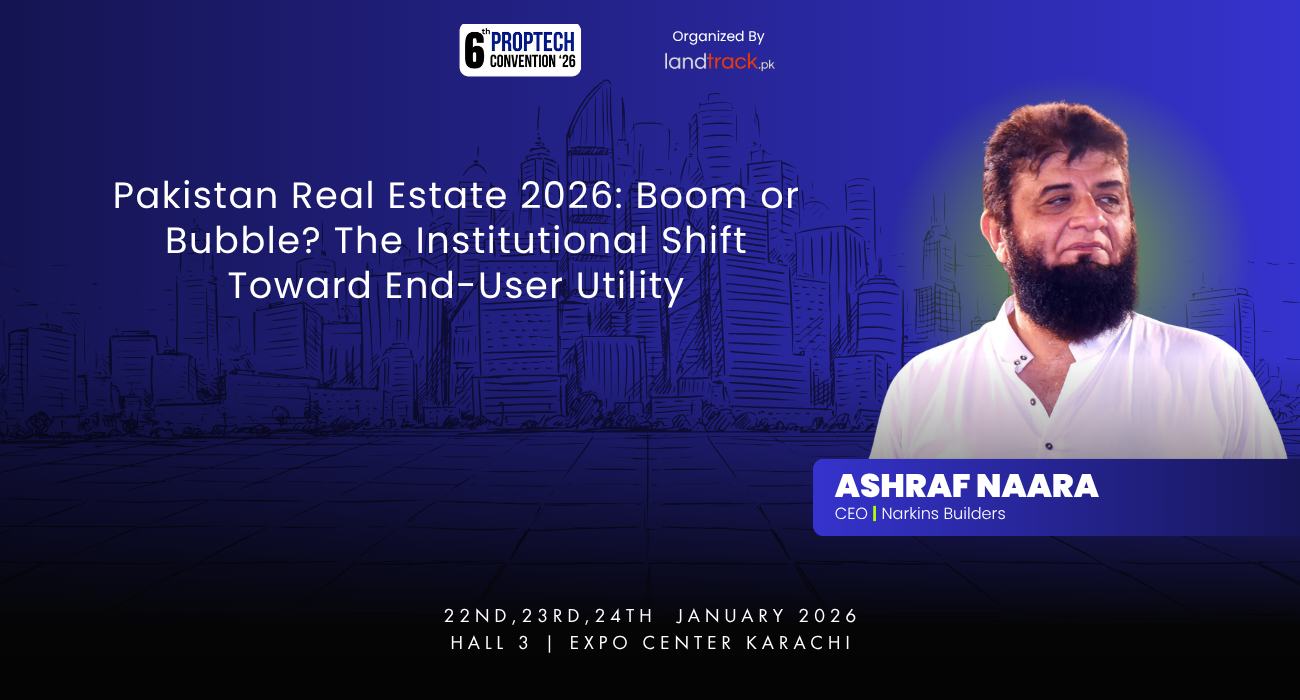
The fundamental difference between a speculative market bubble and a sustainable real estate boom is defined by a single metric: end-user utility. Markets driven purely by the rapid, undocumented flipping of vacant plots eventually collapse under macroeconomic pressure. Conversely, markets anchored by rigorous engineering, tenant-focused infrastructure, and proactive capital management build resilient, generational wealth.
In 2026, as Pakistan’s urban population continues to heavily concentrate in metropolitan hubs—a trend highlighted by the World Bank’s urban development data—the residential and commercial sectors are facing a critical turning point. Addressing institutional investors and policymakers at the Expo Centre Karachi, veteran developer and investor Ashraf Naara laid out a stark, pragmatic blueprint for market survival. His keynote stripped away industry pleasantries, focusing strictly on the brutal economics of project execution, inflation management, and statutory compliance.
The Tripartite Builder-Investor-End User Balance
Historically, the Pakistani real estate sector has operated on an adversarial model: developers prioritize maximum short-term margins, investors seek rapid capital gains, and end-users are left grappling with the resulting compromised living standards. Naara dismantled this paradigm, advocating for a mandatory psychological shift.
A successful project requires the builder to simultaneously analyze the blueprint from the perspective of an aggressive investor and a vulnerable end-user. When a developer steps into the shoes of the final resident to demand enhanced amenities—such as superior fire safety systems or augmented vertical transportation—they must accept a deliberate, calculated compression of their initial profit margins.
However, this “Tripartite Balance” is not a philanthropic exercise; it is a hard-nosed risk mitigation strategy. Projects built with the end-user’s daily friction in mind secure faster occupancies, guarantee investor satisfaction, and solidify long-term Developer Credibility. Ultimately, the initial profit sacrifice is recouped through sustained asset value, market goodwill, and an accelerated sales velocity during subsequent project launches.
Inflation Management & Capital Lock-ins
Over the past three years, Pakistan’s construction sector has been battered by hyperinflation, supply chain bottlenecks, and volatile exchange rates. Many developers reacted to the economic crisis by extracting their capital, pausing construction, and offloading escalation costs onto their buyers.
Highlighting real-world project execution, Naara demonstrated how proactive supply chain management acts as the ultimate hedge against market volatility. Rather than withdrawing liquidity during the economic downturn, his firm doubled down, injecting capital to pre-cure all necessary construction materials years in advance.
Key Metric on Material Procurement:
Historical Lock-in: The firm secured core structural steel at PKR 1.25 Lakh per metric ton.
Market Peak: Shortly after, local market rates for steel spiked to PKR 3 Lakh per metric ton. (For context, independent industry trackers like Kamran Steel have actively monitored these drastic fluctuations).
By locking in heavy materials like steel and electrical wiring two years ahead of the construction schedule, the project insulated itself from local inflation. Crucially, the developer honored the original price agreements with buyers, absorbing any peripheral cost increases without levying controversial escalation charges. This financial discipline allowed them to successfully deliver ground-plus-18-story developments on time, while under-capitalized competitors stalled.
Quality Construction Standards & Safety Engineering
Value preservation in commercial and residential high-rises relies heavily on structural integrity and mechanical efficiency. Naara stressed that Quality Construction Standards must exceed the bare minimums dictated by municipal bylaws.
Vertical Transportation (Elevator Mechanics)
Developers frequently minimize elevator shafts to maximize sellable floor space. Overruling standard architectural advice to install only two elevators, Naara’s firm installed three, recognizing that the psychological friction of wait times severely degrades a building’s premium status. Furthermore, adopting the mindset of an aging or vulnerable end-user, the elevator blueprints were overhauled mid-design to ensure the cabs were deep enough to accommodate medical stretchers. While a standard elevator framework might cost PKR 60 Lakh, upgrading to models with comprehensive safety measures can cost up to PKR 1.5 Crore—an investment that directly protects long-term asset value.
Fire & Life Safety Systems
Safety engineering is frequently treated as a secondary priority in Pakistan’s real estate sector. However, cutting corners on electrical load balancing or cross-ventilation invariably leads to catastrophic asset depreciation via short circuits and fire hazards.
Naara provided a stark comparative analysis of fire suppression economics:
The Baseline Project: To meet completion certificates and honor buyer commitments, Naara’s firm invested approximately PKR 1.5 Crore in a comprehensive fire-fighting and sprinkler system. This included complex installations in poorly ventilated parking zones to ensure zero compliance gaps.
The Competitor Project: A rival development in the same city—double the structural size—bypassed essential safety parameters, spending a mere PKR 50 Lakh on their fire infrastructure. Proportionally, a compliant system for a building of that magnitude should have cost upwards of PKR 2.5 Crore.
While the competitor maximized immediate cash flow, the long-term liability, elevated insurance premiums, and localized risk render such assets toxic to institutional capital seeking compliance with global ESG property frameworks.
Policy Reform: Square Foot Taxation Pakistan
A persistent hurdle in forecasting Pakistan’s real estate trajectory is the opacity of property valuations. The current tax framework often incentivizes the under-reporting of transaction values, heavily feeding a shadow economy. For instance, an asset with a fair market value of PKR 1 Crore is routinely registered at PKR 40 Lakh to evade heavy federal and provincial levies.
To modernize the sector, Naara proposed an immediate transition to a Square Foot Taxation Pakistan model.
Instead of relying on easily manipulated capital value assessments—a system frequently audited and adjusted by the Federal Board of Revenue (FBR)—a fixed, non-negotiable tax levied strictly per square foot would instantly stabilize government revenues. This objective metric bypasses subjective valuations, prevents businessmen from absorbing undocumented losses out-of-pocket, and clearly delineates revenue streams between the Federal Government and Provincial authorities.
Urban Land Value-Addition: The Infrastructure Multiplier
The final pillar differentiating a real estate boom from a bubble is the strategic enhancement of raw land. Speculators trade dirt; developers build ecosystems.
Naara illustrated this with a brilliant master-planning proposal for a commercial zone intersected by an open drainage nullah (canal). Due to the severe odor and aesthetic degradation, adjacent plots were drastically undervalued, trading at roughly PKR 5 Crore.
Instead of viewing the infrastructure liability as a permanent sunk cost, Naara pitched it to municipal planners as a high-yield opportunity. The engineering solution was straightforward:
Subsurface Diversion: Excavate and pipe the wastewater through a sealed, deep underground main.
Surface Beautification: Flood the upper channel with clean water to create an artificial Venice-style canal, complete with traditional recreational boating.
Commercial Zoning: Zone the immediate embankments for high-end retail outlets, mixed-use buildings, and hospitality towers.
By applying standard urban value-addition principles, the exact same parcel of land previously auctioned for PKR 5 Crore could easily command valuations exceeding PKR 25 Crore. This transformation stimulates local tourism, drastically expands the municipal tax base, and proves that intelligent design yields the highest financial dividends.
The Verdict for 2026
Is Pakistan’s real estate market approaching a boom or a bubble in 2026? As developer Ashraf Naara demonstrated, the answer is bifurcated. Projects reliant on undocumented cash flows, speculative plot flipping, and sub-standard engineering are highly vulnerable to the next economic shock. However, for developers who treat real estate as a service—anchoring their portfolios in unshakeable developer credibility, proactive inflation hedging, strict safety compliance, and genuine urban value-addition—2026 represents a massive, high-yield boom. When builders prioritize the physical and financial safety of the end-user, the capital markets will always follow.
Frequently Asked Questions
What determines whether Pakistan’s real estate market is in a boom or a bubble?
A market boom is sustained by end-user utility, high-quality engineering, and transparent project execution. A bubble is driven by the speculative flipping of undocumented plots without any structural value addition or tenant-focused infrastructure development.
What is the Tripartite Balance Model in property development?
It is a strategic development philosophy where the builder analyzes a project from three perspectives simultaneously: their own margins as the developer, the capital safety required by the investor, and the daily living friction experienced by the final end-user.
How does square-foot based taxation benefit Pakistan’s real estate economy?
Transitioning to a square-foot tax model removes the subjectivity of property valuations, reduces the reliance on black economy transactions (where 1 Crore properties are registered at 40 Lakh), and provides guaranteed, objective revenue for both provincial and federal governments.
How can developers hedge against hyperinflation to ensure on-time project completion?
Developers must utilize proactive capital management by locking in structural materials like steel and wiring years in advance. Injecting capital early protects the project from material price spikes and prevents the need to charge buyers unfair escalation fees later
Why is fire and life safety engineering critical for property valuations?
Skimping on fire safety systems (like sprinklers and proper electrical wiring) to save short-term capital creates massive long-term liabilities. Fully compliant buildings prevent asset depreciation via fire hazards, lower institutional insurance premiums, and secure premium investor capital.
How does elevator design impact a residential high-rise's premium status?
Long wait times degrade a building’s premium feel. Installing extra elevators and increasing cabin depth to accommodate medical stretchers reduces end-user friction, fundamentally increasing the property’s safety, usability, and long-term resale value.
What role does urban land value-addition play in infrastructure development?
Value addition transforms environmental liabilities into assets. For example, converting an open drainage canal into a subsurface pipeline topped with a commercial waterway can instantly multiply surrounding land values from PKR 5 Crore to over PKR 25 Crore.
How does the undocumented cash economy affect real estate tax policies?
Heavy, complex taxation incentivizes buyers and sellers to drastically under-report transaction values. This forces the government to rely on inaccurate data and creates massive gaps in national revenue, stalling broader economic infrastructure growth.
Why should builders prioritize the end-user over short-term profit margins?
While building better amenities (like larger elevators or heavy-duty wiring) compresses initial profits, it guarantees higher occupancy rates, builds lasting developer credibility, and ensures rapid sales velocity on future projects, ultimately driving higher lifetime profits.
How will the PropTech Convention 2026 influence Pakistan’s construction standards?
By gathering leading policymakers, developers, and investors, PropTech 2026 acts as a catalyst for shifting the industry away from speculative trading and toward data-driven construction, PropTech integrations, and stringent statutory compliance.