

The Death of Plot Speculation: The Insider Banking Guide to Pakistan Housing Finance, SBP Prudential Regulations, and Mortgageable Land
The Middle-Class Plot Dream vs. Institutional Banking Architecture
For generations across Pakistan, middle-class wealth accumulation has centered on the acquisition of raw, unconstructed land. Salaried managers in corporate hubs, small business owners in regional trade clusters, and non-resident Pakistani (NRP) workers remitting capital from the Gulf share a cultural conviction: purchasing a residential plot is the safest path to intergenerational wealth. Yet this domestic reliance on speculative land acquisition operates in stark contrast to Pakistan’s institutional mortgage infrastructure, where the formal mortgage-to-GDP ratio hovers persistently below 0.5%. In comparison, regional peer India maintains a mortgage-to-GDP ratio near 10%, while developing economies across East Asia regularly exceed 20%.
The public’s expectations frequently clash with the operational realities of banking balance sheets. Middle-class buyers routinely question why commercial banks decline to underwrite twenty-year amortizing loans for empty suburban parcels. This misunderstanding is driven by private developer marketing. Commercial campaigns promote “easy installment plans,” off-plan booking forms, and guaranteed capital appreciation, presenting raw dirt as a sound financial asset that formal institutions ought to finance.
Commercial banks, however, are strictly regulated intermediaries of public deposits. Governed by statutory reserve requirements, asset-liability duration matching, and Basel III capital adequacy frameworks, banks cannot deploy depositors’ funds into unproductive, illiquid dirt. Credit underwriting requires verifiable, recurring, and legally recoverable cash flows to service debt. An empty plot produces zero cash flow, yields no tenant income, and carries significant title and zoning risks. Where the speculative buyer sees safe capital appreciation, a bank’s credit risk committee sees an illiquid asset vulnerable to broad economic shifts.
| Macro-Prudential Indicator | Prevailing Benchmark | Regulatory Reference | Market Impact |
| Mortgage-to-GDP Ratio | < 0.50% | SBP IH&SMEFD / World Bank | Ranks among the lowest formal mortgage penetration rates globally. |
| Maximum Repayment Tenor | Up to 30 Years | SBP SH&SFD Circular No. 04 of 2026 | Lowers monthly amortization burdens to improve debt-service affordability. |
| Commercial Housing LTV Cap | 80% to 85% | SBP Regulation HF-5 | Requires borrowers to commit 15% to 20% in verified personal cash equity. |
| Subsidized Housing LTV Cap | 90% (90:10 Ratio) | Wazir-e-Azam Apna Ghar Scheme | Reduces upfront equity requirements for qualifying first-time homeowners. |
| Statutory DBR Limit | Maximum 65% | SBP Regulation HF-6 | Restricts aggregate personal monthly debt to 65% of net disposable income. |
Why the State Bank of Pakistan (SBP) Strictly Prohibits Speculative Land Loans
The State Bank of Pakistan enforces a strict regulatory boundary: commercial bank credit must never fund bare land speculation. While housing finance was once governed under general consumer finance regulations, the central bank created a distinct regulatory regime via IH&SMEFD Circular No. 03 of 2014, known as the Prudential Regulations for Housing Finance. This framework, updated by SH&SFD Circular No. 04 of 2026, strictly prohibits banks and Development Finance Institutions (DFIs) from underwriting standalone, unconstructed residential plots.
This regulatory stance addresses three primary macroeconomic risks:
Containing Speculative Asset Bubbles and Safeguarding Affordability: Pumping institutional credit into raw land creates speculative cycles. Because land supply within developed urban areas is inherently fixed, speculative bank financing triggers rapid bidding wars. This dynamic artificially inflates land prices without adding any physical units to the housing supply. The resulting land price inflation pushes basic homeownership far beyond the reach of salaried and working-class families, worsening the national housing deficit.
Preventing Destabilizing Collateral Shocks: Unimproved land values fluctuate based on political cycles, interest rate changes, and undocumented capital flows. If banks were to issue long-term loans against volatile land prices, an economic contraction could quickly erode borrower equity. This would leave lenders holding illiquid, devalued collateral that cannot be liquidated without steep balance-sheet write-downs.
Ending Unproductive Capital Sterilization: Speculative land transactions freeze capital in unproductive, dormant assets. Purchasing an empty plot in hopes of capital appreciation creates no sustained employment, generates no continuous tax revenues, and provides zero stimulus to industrial supply chains.
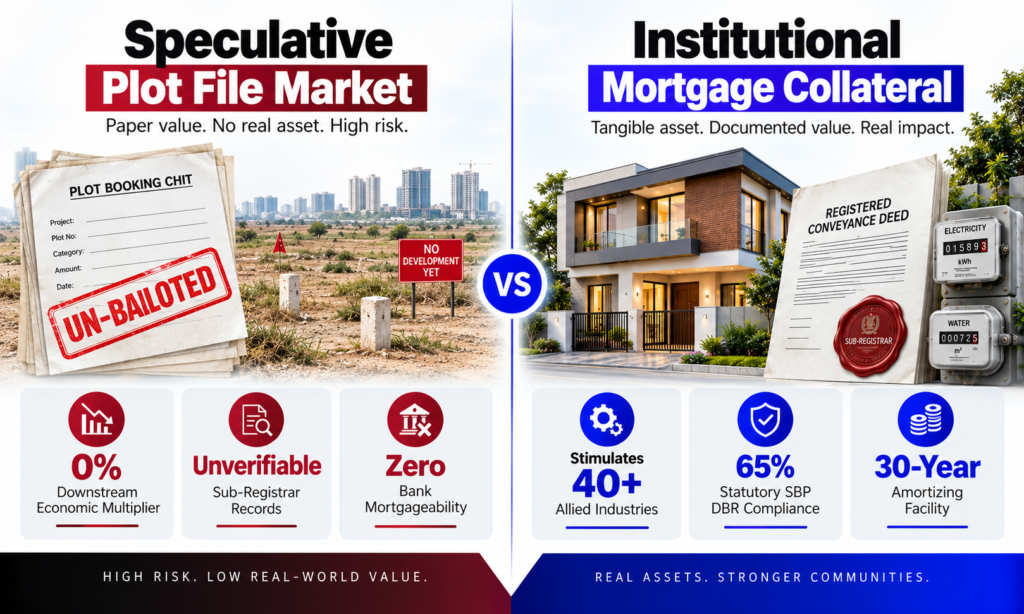
Conversely, channeling credit into physical home construction activates a powerful economic multiplier, stimulating more than 40 allied domestic manufacturing sectors.
| Economic Dimension | Raw Land Speculation (Sterilized Capital) | Physical Home Construction (Productive Capital) |
| Downstream Industrial Impact | Zero; transactions remain confined to paper ledgers and broker commissions. | Directly stimulates 40+ allied industries, including cement, rebar, glass, and wiring. |
| Employment Generation | Negligible; limited to occasional brokerage and legal drafting services. | Creates sustained daily-wage labor for masons, electricians, plumbers, and laborers. |
| Fiscal Revenue Generation | Low; often subject to tax evasion through understated transaction values (DC rates). | Generates verifiable corporate, sales, and municipal tax revenues across supply chains. |
| National Housing Stock | Decreases affordability by locking land away in speculative holding patterns. | Directly adds physical, habitable units to mitigate the national housing shortage. |
| Banking Collateral Stability | High risk; prices are driven by speculation and lack income-generating stability. | Lower risk; structural improvements add durable, income-generating utility value. |
Section 3: The “Files” Dilemma: Why Pakistani Property Speculation Cannot Be Mortgaged
A major structural issue in Pakistan’s property market is the widespread trading of property “files.” These files are paper chits issued by private developers that represent an off-plan promise to deliver an unspecified plot in an un-balloted development. Investors trade these documents across real estate exchanges, yet commercial banks and DFIs are legally barred from accepting them as loan collateral.
| Legal and Structural Parameter | Un-Balloted Property Files PDF | Registered Mortgageable Real Estate MD+ 1 |
| Physical Demarcation | Non-existent; paper chit with no defined ground coordinates. | Fully demarcated site with specific Khasra, sector, and boundary survey marks. |
| Primary Title Document | Internal developer booking chit or provisional allotment slip. | Registered Sale Deed (Baye-Nama) or verified Authority Allotment Letter. |
| Public Registry Integration | Absent; tracked exclusively inside private corporate company ledgers. | Formally entered into Land Revenue mutation records (Intiqal) or Authority Registers. |
| Encumbrance Status | Cannot be verified through public records. | Certified through a Non-Encumbrance Certificate (NEC) from the Sub-Registrar. |
| Lien Perfection Capacity | Legally impossible; no specific parcel exists to attach an equitable mortgage. | Fully enforceable; deposit of title deeds creates a perfected Equitable Mortgage. |
| Development Authority Standing | High risk; frequently marketed before securing layout plan or utility approvals. | Cleared with an approved Layout Plan (LOP) and a formal No Objection Certificate. |
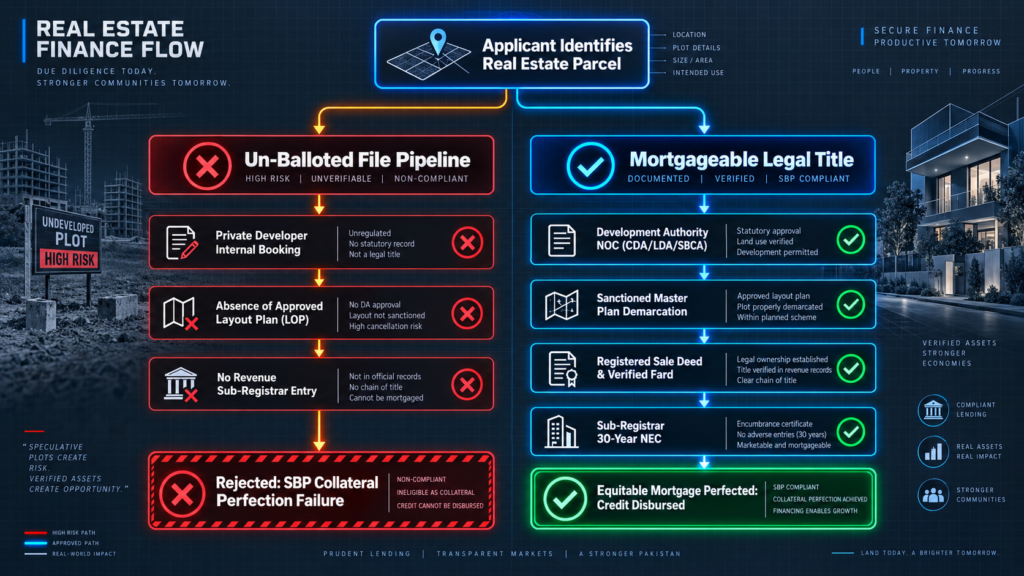
Under Section 58 of the Transfer of Property Act, 1882, a valid mortgage requires the transfer of an interest in specific, clearly identifiable immovable property. An un-balloted file lacks a physical location, recognized boundary lines, and a distinct Khasra number. Because there is no demarcated piece of real estate, there is no underlying property to which a bank can attach a valid security interest.
Furthermore, a file conveys no verifiable legal title through a registered deed or a Fard-e-Malkiat verified by the Land Revenue Department. As revealed in provincial audits of private housing schemes, developers routinely issue files that far exceed the land area they physically own. Without an unbroken chain of title and a verified Non-Encumbrance Certificate (NEC) from the local Sub-Registrar, a bank cannot establish an equitable mortgage or register a legal charge. Accepting an un-balloted file would leave a bank holding an unsecured loan, which directly violates SBP credit exposure limits.
The Plot-Plus-Construction Exception: The Strict Rules of Engagement
Commercial banks and DFIs are authorized to finance land purchases only when bundled into an integrated “Plot-Plus-Construction” or “Plot and Build” financing package. Under these facilities, financing the plot is contingent upon an enforceable commitment to construct a residential home on the site. The bank does not finance land for speculative holding; it provides capital to build an inhabited home.
To prevent borrowers from using these facilities to acquire and hold land speculatively, banks enforce strict operational milestones:
The Ground-Breaking Milestone: The borrower must secure sanctioned building blueprints from the local municipal authority and begin site excavation within 3 to 6 months of the initial plot disbursement.
The Completion Timeline: The entire structure must be built and certified for residential occupancy within 18 to 24 months of the land purchase date.
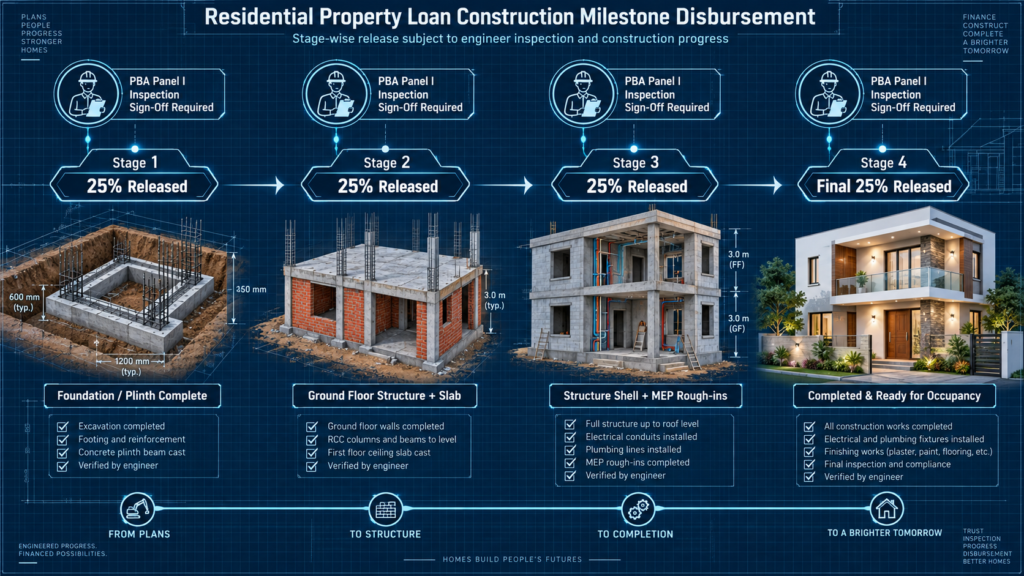
Escrow-Controlled Tranches: Construction funds are withheld in an internal escrow account and released in installments only after on-site physical progress is verified by independent engineering inspectors.
If a borrower halts construction to hold the land speculatively, the loan agreement’s default clauses are triggered immediately. Halting work breaches the underlying financing covenants. The bank will cancel any remaining construction tranches, apply commercial penalty interest rates to the outstanding balance, and demand immediate repayment of all disbursed funds.
If the borrower fails to settle the debt, the bank initiates recovery proceedings under the Financial Institutions (Recovery of Finances) Ordinance, 2001. Under Section 15 of this law, the lender can bypass years of ordinary civil litigation to repossess, foreclose upon, and auction the mortgaged land to recover its debt.
Financing Mechanics: LTV Caps, DBR Thresholds, and Disbursement Tranches
Access to formal housing credit in Pakistan is governed by two key prudential metrics: the Loan-to-Value (LTV) ratio and the Debt Burden Ratio (DBR).
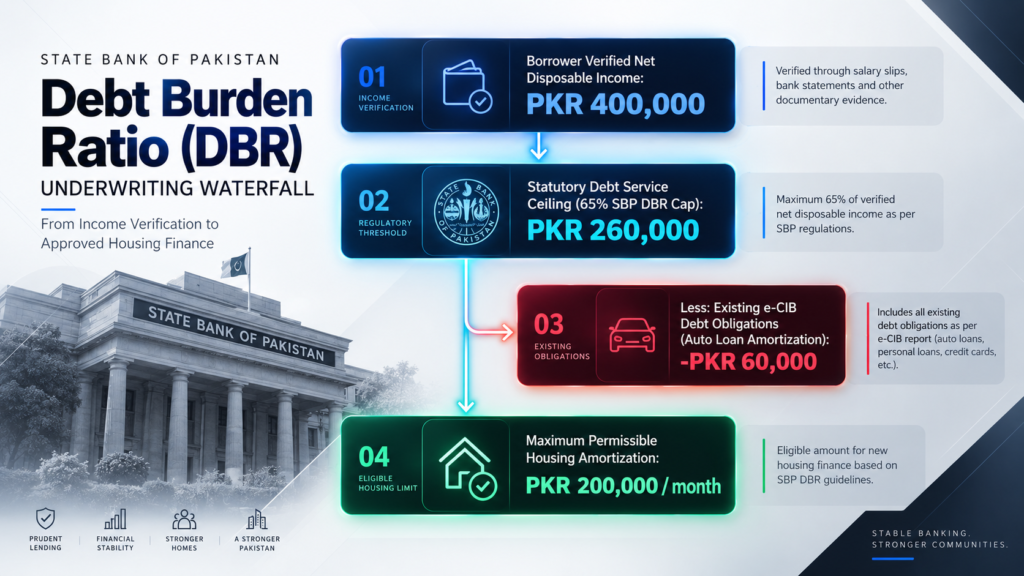
The SBP’s Regulation HF-6 establishes a ceiling on individual leverage by capping the Debt Burden Ratio at 65% of verified net disposable monthly income. This threshold covers all of an applicant’s debt obligations, including the proposed mortgage installment, personal loans, auto leases, and credit card minimums reported by the electronic Credit Information Bureau (e-CIB).
At the same time, central bank regulations cap the Loan-to-Value (LTV) ratio for standard commercial mortgages at 80% to 85% of the property’s independently appraised market value. Under standard commercial Plot-Plus-Construction products—such as those from Bank Alfalah—the total facility is divided between the land and the structure:
Land Financing Allocation: Up to 50% of the approved facility can be used toward the plot purchase.
Construction Financing Allocation: The remaining 50% is reserved exclusively for the building phase.
Upfront Borrower Equity: The applicant must pay their down payment first to complete the land purchase and fund the initial foundation before the bank releases construction funds.
| Commercial Parameter | HBFC (Ghar Sahulat Scheme) MD | Meezan Bank (Easy Builder) MD | Bank Alfalah (Plot & Build) MD+ 1 | HBL (Commercial Mortgage) MD |
| Financing Limit Range | PKR 1.0M to PKR 60.0M | PKR 1.0M to PKR 100.0M | PKR 0.5M to Policy Ceiling | PKR 3.0M to PKR 100.0M |
| Maximum Permissible LTV | Up to 85% of Market Value | Up to 75% (Salaried) / 70% (SEB) | Up to 80% (50/50 Plot/Build Split) | Up to 80% of Appraised Value |
| Benchmark Lending Rate | 1-Year KIBOR + 3.00% to 3.50% | Variable Rental benchmarked to KIBOR | 1-Year KIBOR + 3.00% to 4.00% | Floating KIBOR Variable Spread |
| Tranche Release Schedule | Milestone inspection audits | Land capped at 99%; progress tranches | Plot disbursed; 4 equal build tranches | Milestone-verified disbursements |
| Employment Tenure Bar | 1-3 Years (Salaried/Business) | 2-3 Years in regular industry | 2-3 Years continuous track record | 2 Years verifiable employment |
Construction funds are disbursed in four distinct installments, rather than a single lump sum. Each release is strictly tied to physical milestones verified on-site by accredited engineering inspectors enlisted with the Pakistan Banks Association (PBA).
| Construction Tranche | Allocation Percentage | Physical Verification Prerequisite Milestone | PBA Technical Valuer Scope |
| Tranche 1 (Foundation) | 25% of Construction Facility | Site excavation, structural plinth casting, and ground foundation curing. | Site inspection, boundary verification, and structural foundation sign-off. |
| Tranche 2 (Ground Slab) | 25% of Construction Facility | Ground floor columns cast, brick masonry erected, and roof slab poured. | Verification of covered area dimensions and concrete structural testing review. |
| Tranche 3 (Gray Shell) | 25% of Construction Facility | First floor framing complete, brickwork finished, electrical/plumbing embedded. | Inspection of gray-structure completeness and municipal boundary compliance. |
| Tranche 4 (Finishing) | 25% of Construction Facility | Plastering complete, flooring laid, woodwork done, utilities energized. | Final habitation audit, finish assessment, and completion certificate review. |
Islamic Banking Alternatives (Diminishing Musharakah)
Due to religious considerations, the majority of housing finance in Pakistan is executed through Islamic financial institutions, led by Meezan Bank, Bank Alfalah Islamic, and HBL Islamic. Islamic banks do not issue conventional interest-bearing loans. Instead, they structure plot-plus-construction transactions through the Shariah-compliant framework of Diminishing Musharakah, which is based on Shirkat-ul-Milk (undivided property co-ownership).
In a Diminishing Musharakah transaction:
Establishing Co-Ownership (Shirkat-ul-Milk): The customer and the Islamic bank pool their capital to jointly buy the land and fund the home’s construction, establishing shared legal ownership.
Leasing the Bank’s Share (Ijarah): Because the customer resides in and uses the property, they lease the bank’s undivided share through an Ijarah agreement, paying regular rent to the bank.
Purchasing Equity Units: The bank’s ownership share is divided into fractional units. Over a financing term ranging from 3 to 25 years, the customer pays monthly rent while buying these equity units back from the bank. As the customer acquires more units, the bank’s ownership share decreases, which proportionally lowers the monthly rental payment. Once all units are repurchased, the customer becomes the sole owner of the property and receives full legal title.
For Non-Resident Pakistanis using the Roshan Apna Ghar platform, Islamic banks offer both lien-based and non-lien-based options.
| Islamic Financing Parameter | Standard Non-Lien Diminishing Musharakah MD+ 1 | RDA Lien-Based Islamic Financing MD+ 1 |
| Underlying Collateral | Demarcated real estate mortgaged in favor of the bank. | 100% cash lien over RDA balances or Islamic Naya Pakistan Certificates. |
| Maximum Permissible LTV | Capped between 75% and 80% of property market value. | Up to 99% financing of the underlying property value. |
| DBR Underwriting Bar | Maximum 50% to 65% of verified net disposable income. | Completely exempt from DBR caps; underwritten against pledged liquid collateral. |
| Title Lien Execution | Requires an Equitable Mortgage along with a registered token charge. | Exempt from property mortgage; executed via bank lien on digital deposits. |
| Benchmark Rental Pricing | 1-Year KIBOR + bank profit spread (subject to rate collars). | Discounted benchmark pricing (typically straight 1-Year KIBOR). |
To manage interest rate volatility, Islamic banks often establish rate collars within their Key Fact Statements (KFS). For example, products benchmarked to KIBOR frequently include a contractual rate floor (such as 8.00% per annum) and an upper cap (such as 30.00% to 38.00% per annum). This collar prevents runaway debt service costs during high-inflation cycles while preserving baseline yields for the bank.
Society Installment Plans vs. Commercial Bank Mortgages
Homebuyers in Pakistan often weigh private developer installment plans against regulated commercial mortgages.
| Feature Comparison | Unregulated Society Installment Schemes PDF+ 1 | Regulated Commercial Bank Mortgages MD+ 1 |
| Financing Costs & Mark-up | Marketed as “0% interest,” but finance charges are buried inside inflated base prices. | Transparent pricing benchmarked to KIBOR plus a fixed margin or subsidized fixed rates. |
| Underwriting Scrutiny | Minimal: sales reps rarely require more than CNIC copies and initial down-payment checks. | High: requires 12–24 months of verified bank statements, salary certificates, and e-CIB checks. |
| Title & Regulatory Security | High Risk: vulnerable to unapproved layout plans, missing NOCs, and un-balloted file trading. | Zero Legal Risk: properties must hold a clean, verifiable title and full municipal approvals. |
| Default Penalties | High surcharges, unannounced file cancellations, or total forfeiture of paid installments. | Structured cure periods, formal notices, and legal protections under the 2001 Ordinance. |
| Secondary Resale Liquidity | Volatile: relies on marketing hype, speculative trading, and off-plan broker premiums. | Stable: legal deeds support reliable secondary sales, bank refinancing, and balance transfers. |
Middle-class buyers often enter developer installment schemes because private developers have low documentation requirements. Unregulated developers do not check debt burden ratios, demand verified income slips, or review credit bureau records. They rely on the promise of easy monthly payments to attract buyers.
However, these private schemes carry significant hidden risks. Unregulated developers routinely sell off-plan files before acquiring the necessary land or securing layout plan approvals from local planning agencies. As provincial audit reports consistently reveal, developers often divert early installment deposits into acquiring peripheral land rather than completing pledged infrastructure. Buyers who make payments for years often end up with an un-balloted file in an unapproved development phase that lacks basic utilities and faces municipal demolition orders.
The Practical Playbook for Genuine Homebuyers
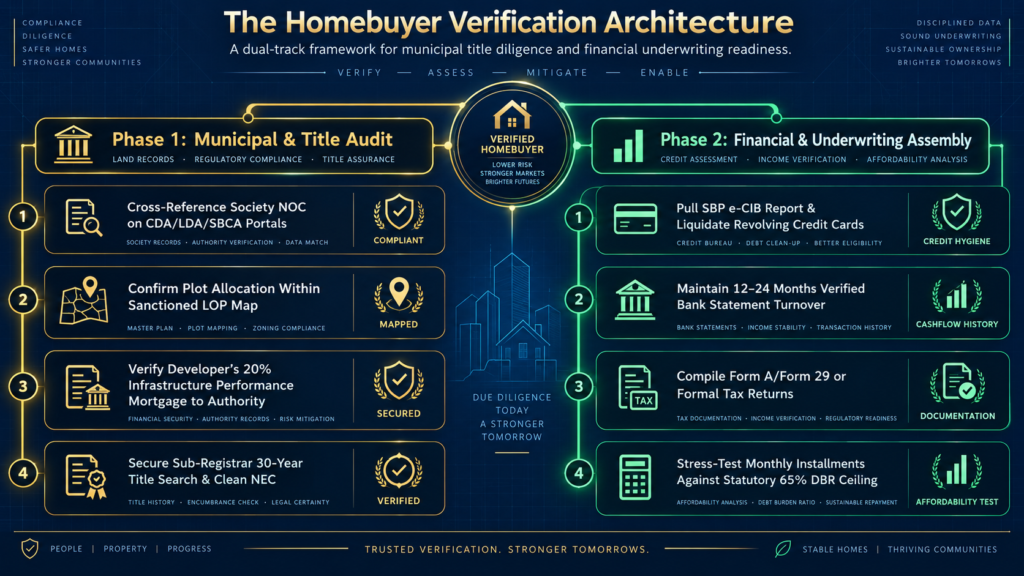
To secure a mortgageable property while avoiding common land scams, buyers should follow a structured due diligence framework covering municipal approvals, title documentation, and financial preparation.
Step 1: Verify Development Authority Approvals
Never purchase land based solely on promotional brochures or marketing maps. Visit the planning portals of the relevant local authority—such as the Capital Development Authority (CDA), Lahore Development Authority (LDA), Rawalpindi Development Authority (RDA), or Sindh Building Control Authority (SBCA):
Verify that the housing scheme holds an active, unrevoked NOC and an approved Layout Plan (LOP).
Confirm that the specific phase, block, and plot number fall within the approved geographical boundaries of the sanctioned LOP, rather than an unapproved expansion[cite: 2].
Ensure the developer has mortgaged the mandatory 20% of saleable area with the regulatory authority as a performance guarantee for roads, water lines, and sewerage networks
Step 2: Scrutinize the Chain of Title
Do not rely on an Intiqal (mutation) entry in village Patwari records as proof of an approved, mortgageable plot[cite: 2]. A mutation is merely a tax-assessment record; it does not grant development rights or confirm zoning compliance[cite: 2]. Insist on an Allotment or Transfer Letter issued through an approved development authority’s centralized registry, or an unbroken 30-year chain of registered title deeds (Registry) accompanied by a clean Non-Encumbrance Certificate (NEC) from the Sub-Registrar.
Step 3: Document Informal Income Through Proxy Underwriting
Salaried professionals with regular payslips and tax records fit neatly into standard underwriting processes. However, self-employed individuals and informal earners often lack corporate financial statements. To expand access to credit, the SBP issued SH&SFD Circular Letter No. 04 of 2026, directing commercial banks to utilize standardized informal income estimation models developed with the Pakistan Banks Association (PBA). Low-cost housing finance facilities are also exempt from standard DBR rules when banks apply these approved surrogates.
| Underwriting Segment | Standard Income Documentation MD+ 1 | PBA Proxy Surrogate Alternative MD |
| Salaried Individuals | Computerized salary slips, employment letters, and 6–12 months of bank salary credits. | Employer HR confirmation, provident fund statements, and continuous utility invoices. |
| Self-Employed (SEP/SEB) | Audited corporate financials, tax returns, and 12–24 months of business bank records. | Documented bank turnover, trade inventory audits, and supplier payment receipts. |
| Informal Sector Earners | Formal accounts often unavailable; applications routinely fail standard DBR reviews. | 24-month utility statements, verified rent track records, and fee receipts. |
Informal earners can document their repayment capacity by compiling secondary financial records over an 18 to 24 month period:
Maintain uninterrupted utility bills (electricity, gas, and telecommunications) to verify regular operational expenses.
Route business revenues through an active bank account to build a clear record of turnover, avoiding unrecorded cash transactions.
Compile rent agreements, rent payment receipts, and school fee challans to establish a consistent pattern of household cash outflows.
These alternative financial records allow PBA-enlisted income evaluators to construct a formal cash-flow assessment. This documentation enables informal and self-employed buyers to qualify for regulated long-term mortgages without relying on high-risk developer installment schemes.