

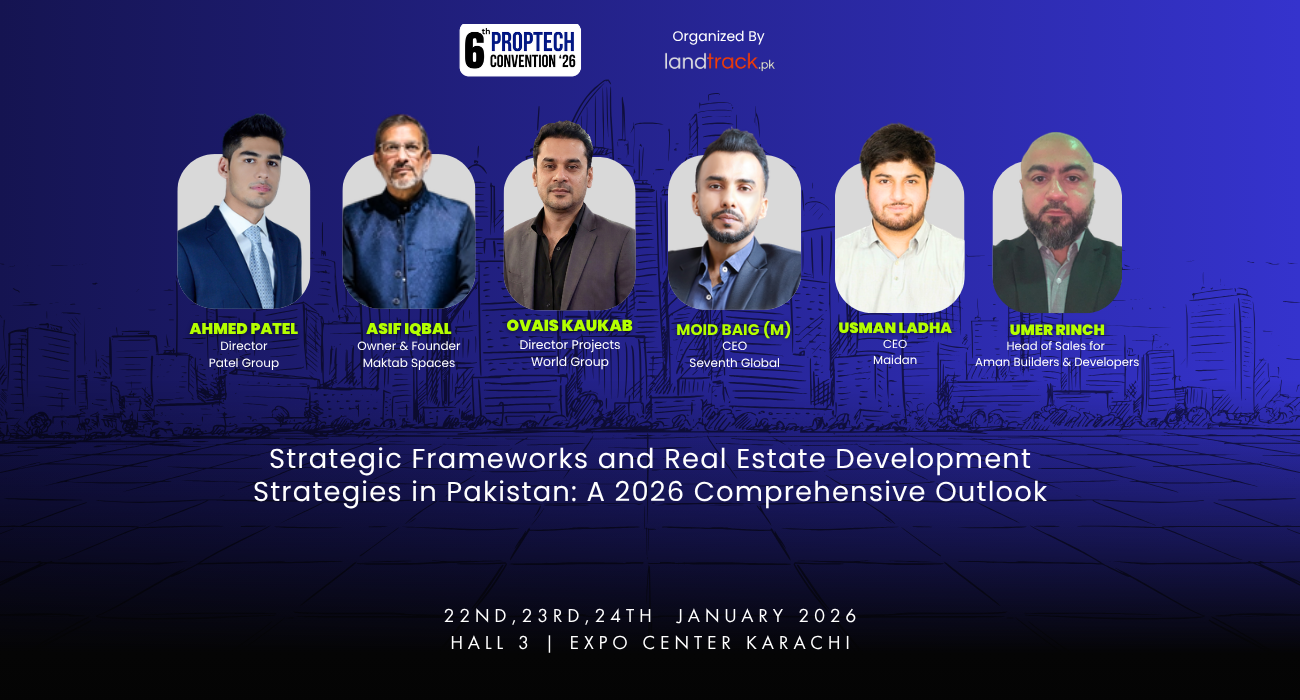
The landscape of real estate development in Pakistan stands at a historic crossroads in 2026, transitioning from a decade defined by speculative, land-based trading toward a high-utility, technology-driven ecosystem. This metamorphosis represents a fundamental restructuring of how value is created, captured, and sustained within the urban environment. Driven by macroeconomic stabilization, technological disruption, and shifting consumer demographics, real estate development strategies are rapidly evolving to prioritize long-term asset management over short-term capital gains.
As the real estate industry matures, it is moving away from the vulnerabilities of the traditional “Build to Sell” (BTS) model toward a more sustainable “Build to Operate” (BTO) framework. This evolution was on full display during the 6th PropTech Convention, which served as the primary platform for aligning policy, capital, and technology to address the future of the sector. For deeper context on these transformative discussions, you can review Insights from the PropTech Convention 2026.
The Paradigm Shift: Insights from the Real Estate Panel Discussion
During a prominent real estate panel discussion at the convention, leading developers and service operators dissected the shifting dynamics of the property market. Their insights highlight a critical realization: builders and developers pakistan can no longer survive by merely selling square footage; they must sell integrated lifestyles, community belonging, and operational excellence.
Asif Iqbal: The Transition to Real Estate as a Service (REaaS)
Asif Iqbal Sheikh, a finance professional who transitioned into shipping, real estate construction, and now the service industry, highlighted the urgent need for developers to evolve. Recognizing the shift in consumer demands, he advocates for a transition from merely building structures to operating service-oriented ecosystems.
Key Insight: “We should dedicate the roof for Maidan… and we should dedicate one floor for coworking space,” Asif proposed to his fellow developers.
The Strategy: He advises developers against selling every unit, specifically suggesting they retain at least the ground floor or a 5,000 to 10,000 square foot space to partner with a coworking operator. By converting these spaces into incubation centers, developers can foster community interaction where residents can “sit in the incubation center… discuss ideas, and then pitch them on Pakistan’s Shark Tank”. This not only acts as a Corporate Social Responsibility (CSR) initiative but significantly boosts the appreciation value of the property.
Owais Qaqab: Livable Societies and Perpetual Income
Representing World Group, Owais Qaqab focuses heavily on the “live, work, and play” concept to create “Livable Societies”. His philosophy centers on generating perpetual revenue from amenities to fund the long-term maintenance of the project, ensuring the building does not degrade over time.
Key Insight: “Just not to sell square feet, we need to sell the livability, we need to sell the lively neighborhood,” Owais explained.
The Strategy: Owais emphasized the importance of generating “perpetual income” by reviving dead spaces—such as utilizing rooftops for elevated solar gardens while placing cafes or gyms underneath. The revenue generated from these retained, publicly accessible assets is then reinvested directly into the project’s upkeep. This prevents a scenario where, after 10 years, a project’s paint deteriorates and it becomes “lawaris” (abandoned/unmaintained). By maintaining the asset properly, the developer protects their brand legacy for 99 years, creating a win-win situation for both the consumer and the builder.
Umar Range: First Impressions and Legacy Building
Umar Range, representing Aman Builders and Developers—a firm with over 37 years of experience constructing apartments across Karachi—focused on elevating architectural standards and the psychological impact of design.
Key Insight: Umar proudly claimed that in their recent Malir project, Aman Builders constructed a massive 6,000 square foot lobby in a residential project, setting a new benchmark for the country.
The Strategy: He urged property developers to ask themselves, “Are we here to make money only or make a legacy as well?”. Moving beyond standard amenities like gyms and swimming pools, Umar envisions the integration of health care clinics and kindergartens directly into residential towers, much like the standards seen in Dubai. Implementing this vision requires developers to act philanthropically, occasionally compromising short-term profit margins to cultivate a sense of community responsibility and elevate the overall standards of real estate pakistan.
Usman Ladda: Social Multipliers Through “Maidan” Integration
Usman Ladda, Co-founder and CEO of Maidan, brings the perspective of sports facility management into urban planning. He views sports not just as a physical activity, but as a crucial community-building tool.
Key Insight: Addressing the challenge of maintaining amenities, Usman stated, “We work on two models… You build it, we operate it… or we build it and operate it on a rental model”.
The Strategy: Usman highlights the growing societal issues of excessive screen time and deteriorating mental health, positioning sports facilities as vital infrastructure to combat these challenges right underneath residents’ homes. By collaborating with developers to activate empty or unmanaged spaces, operators like Maidan can generate shared revenue while significantly enhancing the lifestyle offering of the property.
The Strategic Pivot: Build to Sell (BTS) vs. Build to Operate (BTO)
A core consensus emerging among forward-thinking stakeholders is the necessary pivot from traditional, high-risk sales models to stable, yield-bearing operational models. Historically, real estate pakistan heavily relied on the BTS model, utilizing pre-sales and off-plan installments to fund development. While this allowed for rapid capital turnover and high initial returns, it left the developer—and the market—vulnerable to price volatility and interest rate hikes.
In 2026, the BTS model is becoming more disciplined. Conversely, the BTO model represents a paradigm shift where developers focus on “Integrated Master Developments” and prioritize recurring revenue streams from malls, hospitality, and managed residential portfolios. As Owais pointed out, the revenue from these retained assets acts as an economic anchor, subsidizing maintenance costs and elevating the long-term capital appreciation of the building. Property investment portfolios that include defensive recurring income streams are proving to be significantly more resilient.
Capital Discipline and Large-Scale Construction Projects
As the market transitions, capital discipline has become the defining characteristic of successful operators. In 2026, the era of unchecked speculative launches is fading; investors and institutional buyers are now guided by the “70% Rule”. This vital metric dictates that capital should only be committed to documented projects where at least 70% of physical infrastructure (roads, sewerage, utility grids) is visibly complete on the ground. This filter efficiently separates resilient, well-capitalized operators from liquidity-stressed borrowers, actively rebuilding investor trust. Implementing strict operational hygiene and effectively managing construction credit risk and capital discipline are now prerequisites for survival.
Furthermore, government intervention continues to shape large-scale construction projects. The Apna Ghar subsidy scheme, injecting PKR 321.96 billion to finance up to 500,000 homes over a four-year period, acts as a massive economic multiplier. This initiative not only addresses the severe housing shortfall but drives massive demand across allied industries such as cement, steel, and electrical equipment.
PropTech, AI, and Market Sustainability
Technology is no longer a future promise; it is the current reality of modern development in Pakistan. During the recent industry summits, architectural experts like Ar. Sobiya Munawar detailed how Artificial Intelligence (AI) and Building Information Modeling (BIM) are revolutionizing creative workflows and reducing construction waste, thereby directly improving market sustainability. Developers are leveraging Large Language Models (LLMs) and predictive analytics to optimize spatial details, automate customer support, and forecast market trends with unprecedented accuracy.
Simultaneously, blockchain technology is emerging as a critical regulatory tool for decentralization and transparency. Real Estate Tokenization is breaking down high-rise commercial assets into fractional shares, democratizing investment and allowing a broader demographic to participate in high-yield markets.
However, technological advancement must run parallel to environmental ethics. Real estate globally contributes to nearly 40% of energy consumption and 20% of greenhouse gas emissions. As research indicates, the impact of unplanned urban expansion in Pakistan has historically led to ecological encroachment and the displacement of local communities. Consequently, developers are recognizing that integrating environmental sustainability in real estate and adopting climate-conscious designs are no longer optional luxuries, but strict regulatory and financial necessities. Sustainable growth in real estate demands an interdisciplinary approach that balances dense vertical expansion with ecological preservation.
Alternative Asset Classes: The Rise of Data Centers and REITs
As the market normalizes, alternative real estate asset classes are coming of age. The focus is expanding beyond traditional residential and commercial properties into specialized infrastructure. For instance, data centers are emerging as a structurally attractive alternative real estate asset class, offering USD-linked yields of approximately 7%. A 60-MW demand gap and limited Tier-III capacity underpin this growth, positioning data centers for rising institutional interest.
Institutional capital, which selectively re-entered the market in 2025 with over PKR 60 billion deployed across commercial real estate, is expected to assume a more structurally anchored role in 2026. This includes the anticipated PKR 20-25 billion in capital expected to be raised through REITs and IPOs, signaling a market that is increasingly focused on pricing accuracy, income durability, and transparent governance over speculative velocity.
Conclusion: The Future of Urban Development Pakistan
The trajectory of the market in 2026 confirms that the old playbooks are obsolete. To succeed, builders and developers pakistan must fully embrace their new roles as service providers and community creators. They must prioritize interconnectedness, eliminating the “traffic-congested” mindset in favor of walkable, heavily amenitized neighborhoods.
Institutional capital has recognized this shift, deploying heavily into transparent commercial corridors. For the individual investor evaluating property investment, the highest yields are migrating toward vertical density in metropolitan hubs like Karachi and Lahore, where rental yields of 4-6% are becoming standard. Furthermore, the strategic pivot toward the “Blue Economy” is transforming coastal regions into high-utility tourism ecosystems.
Ultimately, the most successful property development strategies moving forward will be those that integrate empathy into their economics. By committing to the “Build to Operate” philosophy, enforcing strict capital discipline, integrating proptech innovations, and prioritizing holistic human well-being through amenities like coworking spaces and sports maidans, developers can ensure their projects transcend mere concrete and steel. They will build legacies, foster genuine community belonging, and secure enduring profitability for generations to come.