

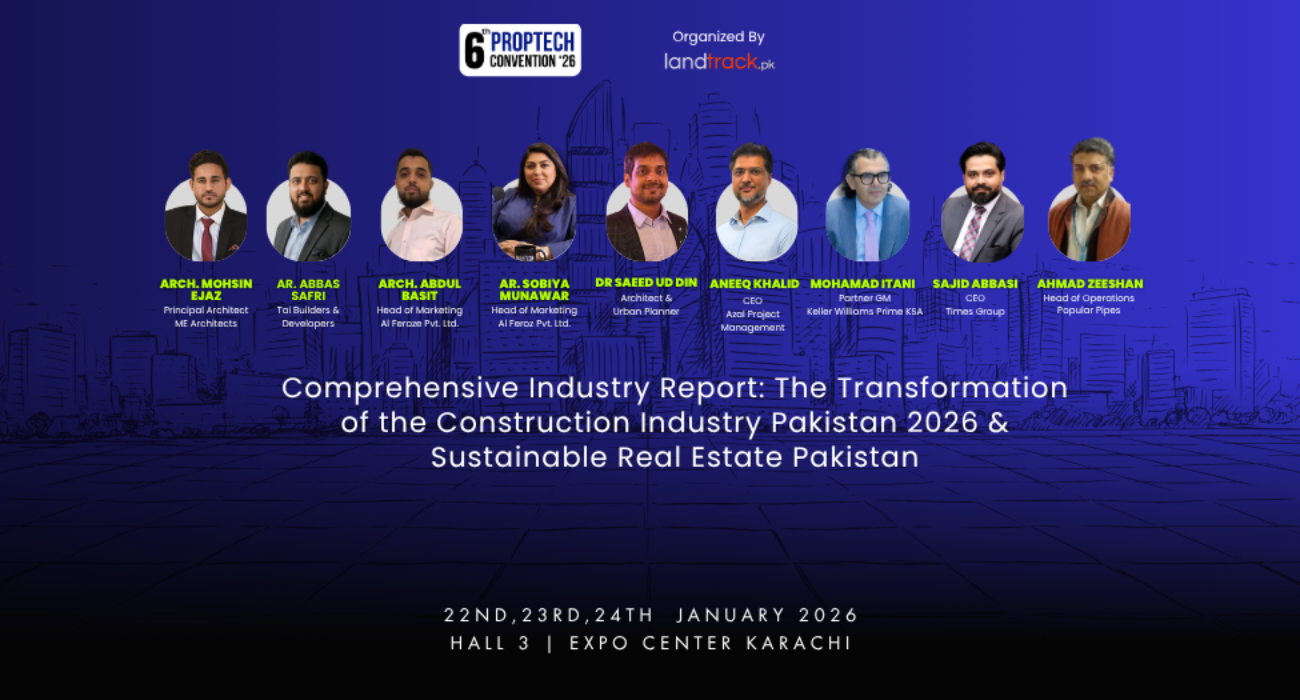
1. Introduction: The Structural Shift in Pakistan’s Built Environment
The transition of the Pakistani built environment in 2026 is defined by a shift from speculative, paper-based plot trading to highly integrated, documented, and climate-resilient development. Driven by intense macroeconomic stabilization under International Monetary Fund (IMF) guidelines, a severe urban housing deficit, and a growing domestic vulnerability to climate disasters, the Construction Industry Pakistan 2026 is forcing a radical structural evolution across all real estate asset classes.
For decades, real estate development prioritized rapid short-term monetization over architectural innovation, resulting in a systemic execution deficit and design monotony. In this context, insights from the PropTechConvention2026 provide a detailed diagnostic of the financial, legal, and material realities dictating Sustainable Real Estate Pakistan. The core consensus among industry professionals is clear: design is an active responsibility, structure defines a long-term legacy, and developers must transition away from isolated, short-term completions toward comprehensive, multi-decade lifecycles.
2. Urban Planning Pakistan and the Implementation Gap
A primary crisis within Urban Planning Pakistan is the profound disconnect between master-plan formulation and municipal execution. While architectural visions are often expansive, local developments frequently function within isolated silos that fail to communicate with broader civic components.
The Breakdown of Municipal Infrastructure Strategy
According to Dr. Saeed Ud Din Ahmed, an associate professor and urban governance consultant, sustainable planning cannot exist within isolated real estate projects. He notes that the previous major structural guideline for Karachi, the KSDP 2020, expired without an immediate seamless successor , while the upcoming Karachi Strategic Plan 2047 remains actively in development. This temporal gap exacerbates unregulated sprawl, forcing millions into informal settlements due to a severe mismatch between market supply and actual demographic demand. Dr. Saeed Ud Din Ahmed emphasizes that while the KSDP 2020 forecasted an annual demand for 100,000 housing unit pipelines in Karachi, private market supply heavily skewed toward high-income groups, leaving low-and-middle-income segments completely unserved and driving the growth of unmapped katchi abadis.
Furthermore, public capital spending and municipal budget allocations remain entirely disconnected from formal urban guidelines. Project funding is historically distributed on an annual, localized basis via political mandates rather than being anchored to comprehensive blueprints like the Quetta City Master Plan or the Karachi Climate Action Plan. This structural failure manifests in populist housing schemes that complete concrete envelopes without providing basic access to localized water, power, and sanitation grids.
Design Monotony and Spatial Context
The commercial real estate landscape suffers from severe visual and functional stagnation. Arch. Mohsin Ejaz, serving as a strategic panel moderator, points out a striking historical anomaly: for over sixty years, the Habib Bank Plaza (constructed in 1960) stood alone as the celebrated pinnacle of South Asian verticality, with only the MCB Tower emerging as a subsequent notable high-rise addition in the following decades.
This lack of iconic landmark high-rises does not stem from a deficit in local creative talent. Operating in a globalized ecosystem, developer entities possess the capital to engage world-class international architects. Instead, Arch. Mohsin Ejaz and other specialists argue that the deficit is caused by a lack of robust market competition, deficient developer visions, and severe financial limits. This commercial environment yields a repetitive cycle of “design monotony,” where developers routinely duplicate layout blueprints from their first successful projects onto subsequent developments, completely ignoring localized spatial contexts and long-term community needs.
3. Building Code Compliance Pakistan and Structural Integrity
Enforcing technical building standards remains an existential hurdle for the sector. Statistics reveal that approximately 10% of housing units qualify as engineered structures. This indicates that roughly 90% of the population resides in buildings erected without certified architectural or engineering oversight, leaving urban agglomerations critically vulnerable to seismic actions and severe monsoon-related damage.
The BCP 2021 Legal Architecture
To counter this systemic exposure, the primary legal benchmark is the Building Code of Pakistan (Building Code Compliance Pakistan or BCP 2021). Developed by the Pakistan Engineering Council (PEC) with assistance from the World Bank and NED University, the BCP 2021 is modeled directly on the International Building Code (IBC). The framework institutes explicit, mandatory rules for:
Dynamic Seismic Hazard Analysis based on real-time meteorological and geological data.
Ductile detailing of structural steel reinforcing bars.
Precise calculations for concrete durability and soil mechanics.
Despite these regulations, structural failures and site accidents remain high. Senior field professionals, including Engr. Sohail Aziz, observe that high failure rates are directly tied to weak enforcement by municipal agencies, inadequate corporate safety budgets, and a lack of formalized contractor safety training.
Mitigating Regulatory Friction through PropTech
To simplify compliance and eliminate bureaucratic blockages, Ar. Sobiya Munawar announced the launch of an AI Agent for Land Bylaws. This single-window digital tool allows architects, urban planners, and engineering firms to immediately contrast building regulations across conflicting jurisdictional bodies, such as the Lahore Development Authority (LDA), Capital Development Authority (CDA), and Sindh Building Control Authority (SBCA). By leveraging automated reasoning models, this platform validates site plan parameters against localized municipal codes prior to breaking ground, mitigating structural non-compliance and optimizing project timelines.
4. Material Demands: Construction Standards and Project Execution
Achieving long-term Structural Integrity in Modern Developments requires a rigorous alignment of procurement with strict Construction Standards and Project Execution. In the coastal and inland zones of Pakistan, building materials are routinely exposed to aggressive environmental elements, particularly during the intense monsoon season.
Foundation Engineering and Moisture Management
A leading cause of premature structural deterioration in Pakistani real estate is the systemic omission of a correctly detailed Damp Proof Course (DPC) combined with low-grade concrete formulations mixed with silt-heavy sand. The DPC serves as a vital horizontal moisture barrier placed at the base of masonry walls to arrest capillary water migration from foundations into sub-structures. For projects situated on clay-heavy, moisture-retaining soils common across Punjab, hydrostatic pressure accelerates ground-water ingress.
To counter this, specific structural guidelines dictate the application of high-performance materials:
| Material Type / Factor | Ideal Soil / Structural Condition | Technical Standard & Local Cost Baselines | Long-Term Durability & Structural Impact |
| Sulphate-Resistant Cement (SRC) | Clay-heavy soils exhibiting high moisture retention and hydrostatic pressure. | Applied directly in foundation footings and basement slabs; valued at 1,550–1,750 PKR per bag. | Insulates and protects foundational concrete elements against sulfate attacks and subterranean groundwater degradation. |
| Ordinary Portland Cement (OPC) Grade 53 | General structural superstructure framing, including columns, beams, and external plaster. | Specified for high-load casting and weather-exposed plastering; valued at 1,400–1,600 PKR per bag. | Secures target 28-day compressive strength limits and reduces micro-cracking across structural elements. |
| APP Bituminous Membrane (3mm) | Exposed flat roofs, podium decks, and horizontal concrete surfaces prone to standing water. | Full-surface roof waterproofing application; valued at 150–250 PKR per sq ft. | Blocks downward water ingress and prevents severe concrete spalling during heavy monsoon rainfall cycles. |
| Damp Proof Course (DPC) | Wall bases situated immediately above established ground levels. | Mandated by the National Building Code; utilizes advanced bituminous felt or crystalline slurry mixtures. | Builds an impermeable barrier against rising damp, stopping surface efflorescence and preserving masonry integrity. |
To maximize material efficacy, site planning must include a natural drainage gradient of at least 2% sloped away from the primary structure, coupled with heavy-duty uPVC roof drainage lines and centralized underground collection networks. For comprehensive guidance on regional structural protection, engineering firms reference the latest Monsoon-Proof Construction in Pakistan Standards.
Core Structural Materials: Steel and MEP Systems
The structural matrix of Pakistan remains heavily dominated by Reinforced Cement Concrete (RCC) framing. Ahmad Zeeshan, an operations authority and structural reliability expert, stresses that fluid transport networks represent the interior vascular system of a high-rise tower. He remarks that building occupants frequently face damaging water seepage within months of project completion due to uncertified MEP configurations. To reverse this trend, his firm restricts the specific gravity of its unplasticized polyvinyl chloride (uPVC) products between 1.42 and 1.46, matching strict global durability standards to guarantee an operational lifespan of at least 60 years. Furthermore, Ahmad Zeeshan highlights that the firm introduced lead-free uPVC and PPRC formulations to protect potable water systems from heavy-metal contamination, ensuring environmental safety and occupant health.
Regarding structural reinforcement, Danial from Union Steel notes that the domestic market has evolved from using un-graded, low-ductility “local” twisted steel toward highly standardized, graded deformed rebars. Modern production facilities employ advanced, imported automated plants with internal, continuous testing laboratories. This setup tracks batch heat chemistry in real-time to avoid micro-structural anomalies, ensuring that structural engineering tolerances are verified before shipping to construction sites.
5. PropTech, Digital Twins, and AI: Modern Real Estate Development
The transition toward Smart Cities Development in Pakistan depends on substituting subjective, manual inspection models with precise digital validation platforms. The inclusion of advanced PropTech architectures creates data-driven workflows that eliminate common execution discrepancies.
Digital Twins and BIM Integration
Arch. Abdul Basit, a Senior Project and Product Management specialist at VentureDive, advocates for the immediate adoption of Digital Twin technology. By generating real-time, sensor-linked digital replicas of active physical structures, engineering teams can continuously monitor stress variables, track moisture absorption rates, and mathematically verify the exact volume of work completed.
Simultaneously, Building Information Modeling (BIM) platforms allow for cross-departmental coordination. Ar. Sobiya Munawar notes that while creative AI tools like MidJourney and DALL-E have transformed conceptual design visualization, integrated BIM systems enable architects and MEP engineers to perform advanced clash-detection, optimize resource allocation, and design highly energy-efficient envelopes before fabrication. This systematic verification is supported by Abbas Safri, who promotes flowchart-driven system processes to validate structural calculations, piping pathways, and foundation stresses prior to site assembly.
Grounding Marketing Narratives in Engineering Truth
To restore institutional investor trust, real estate marketing must move away from speculative, exaggerated representations. Communication design specialists, including Aneeq Khalid, point out that architectural visual representations and digital video commercials must match physical realities. By locking AI-driven conceptual models directly into verified engineering parameters, developers can ensure that client mood boards correspond with the actual material specifications of the finished structures.
6. Financial Restructuring and Lifecycle Thinking
Adopting Lifecycle Thinking in Real Estate Projects requires a profound financial and operational overhaul. The historically volatile Pakistani real estate landscape, characterized by short-term land speculation and unfinished developments, is being systematically reorganized through strict regulatory frameworks.
SBP and SECP Regulatory Overhauls
The State Bank of Pakistan (SBP) and the Securities and Exchange Commission of Pakistan (SECP) have established rigorous operational guardrails to enforce capital discipline and protect retail investors:
Mortgage Debt-to-Equity Cap: Capped strictly at 85:15 by the SBP, opening structured housing credit channels for the middle-class segment while preventing subprime over-leveraging.
Monthly Amortization Threshold: Restricted to a maximum of 50% of a borrower’s net disposable income, mitigating consumer default exposure across commercial banks.
Prohibition on Bare Land Financing: The SBP strictly prohibits banking liquidity from funding unapproved plots or raw, speculative land trading, forcing capital allocation directly into vertical density and active construction.
REIT Capital Discipline: The SECP mandates that Real Estate Investment Trust (REIT) schemes must achieve public listing on the stock exchange within one year of property transfer. Critically, REIT development capital disbursements are legally restricted until at least 70% of physical infrastructure is completed on-site, effectively ending speculative project launches. To review the complete regulatory parameters, developers track the Securities and Exchange Commission of Pakistan REIT Asset Registry.
Capital Formalization and Fractional Investment
Sajid Ali Abbasi, Founder and Group CEO of Times Group, demonstrates how these strict financial frameworks can scale sustainable industrial assets. Partnering with the U.S. Trade and Development Agency (USTDA), his organization initiated a landmark feasibility study for a waste-to-energy biofuels facility in Karachi’s Landhi Cattle Colony, illustrating how advanced engineering can resolve municipal waste issues. Sajid Ali Abbasi emphasizes that industrial assets—including modernized logistics hubs and compliant warehousing complexes—must be built to the highest material standards to support national port capabilities and serve as stable, high-yield products for institutional funds.
Furthermore, international real estate strategist Mohamad Rabih Itani explains that combining listed REITs with blockchain-enabled fractional property ownership will significantly broaden access to the market. Specialized fractional engines allow smaller retail buyers to purchase fractional equity stakes down to 100 square feet, democratizing entry into prime, high-yield commercial assets. Mohamad Rabih Itani observes that as global proptech ecosystems expand, attracting international buyers requires offering sustainable, highly secure, and energy-optimized properties that provide long-term asset value protection over quick resale turnover.
7. Strategic Synthesis: The Sustainable Real Estate Road Map
The evolution of the Pakistani built environment requires a systematic departure from traditional, speculative building models. Building a transparent, efficient, and resilient market demands that developers, engineers, and financial networks commit to four foundational initiatives:
Deploy Advanced PropTech Configurations: Shift project management tasks onto real-time Digital Twin frameworks and BIM engines to eliminate construction site execution errors, track material aging, and verify that the final structures match their approved engineering drawings.
Enforce Capital and Code Alignment: Ensure absolute compliance with the BCP 2021 code while utilizing next-generation automated tools, like the Land Bylaws AI Agent, to remove municipal alignment risks and streamline approval pathways.
Transition to Climate-Adapted Materials: Focus on long-term structural durability by mandating specialized Sulphate-Resistant Cement for foundational elements, applying continuous 3mm APP bituminous waterproofing membranes, and embedding pre-installed solar configurations to lower grid dependence and operational carbon footprints.
Scale Regulated Financing Frameworks: Maximize use of listed REIT structures and audited fractional property platforms to formalize domestic real estate capital, increase transaction transparency, and direct liquidity toward well-planned, high-density urban centers.
Verifiable Industry Reference Directories
Explore legal building guidelines and seismic parameters directly via the Pakistan Engineering Council BCP Framework Registry.
For detailed coverage on urban metrics and housing shortages, view the PropTech Convention Housing Blueprint Directory.
Review infrastructure feasibility metrics and environmental targets on the United States Trade and Development Agency Pakistan Briefing Hub.
Frequently Asked Questions
What are the building code compliance challenges in Pakistan real estate?
Building code compliance challenges stem from weak municipal enforcement, inadequate developer safety budgets, and a lack of contractor safety training. This leaves roughly 90% of the population living in non-engineered buildings highly vulnerable to severe seismic hazards and intense monsoon damage.
Why is lifecycle thinking crucial for sustainable real estate Pakistan?
Lifecycle thinking is crucial because it shifts focus from short-term land speculation and rapid project sales to multi-decade structural survival. It mandates pre-installed solar grids, water conservation, and long-term asset value preservation over quick developer cash turnover.
How does the Building Code of Pakistan 2021 ensure structural integrity?
The BCP 2021 ensures structural integrity by mandating dynamic seismic hazard analysis, structural steel ductile detailing, and strict soil mechanics specifications based on the International Building Code (IBC) to survive extreme environmental stress.
What role does PropTech play in the construction industry Pakistan 2026
PropTech transforms construction by integrating Digital Twin models, AI automated land-bylaw compliance agents, and Building Information Modeling (BIM). These tools replace manual site validation with real-time data to eliminate structural errors and material quality fraud.
Which quality construction materials are mandatory for monsoon waterproofing in Pakistan?
Mandatory materials include Sulphate-Resistant Cement (SRC) for foundations, Ordinary Portland Cement (OPC) Grade 53 for superstructures, and a 3mm APP Bituminous Membrane for flat roofs. These must be combined with a 2% slope drainage gradient.
How do SECP regulations protect investors in Pakistani REIT schemes?
The SECP protects investors by requiring REIT listings within one year of land transfer and completely blocking development funding until 70% of physical infrastructure is physically complete on-site, eliminating developer default risks.
Why does the State Bank of Pakistan restrict financing for unapproved plots?
The SBP prohibits financing for unapproved plots or bare land to eliminate speculative, non-documented cash trading. This directly funnels banking liquidity into active vertical construction and higher sustainable urban density.
How does Digital Twin technology improve construction standards in Pakistan?
Digital Twin technology creates real-time virtual replicas of physical buildings. This allows engineering teams to continuously track material aging, monitor structural stress variables, and accurately verify completed site work with objective data.