

For decades, the Pakistani real estate sector viewed fire safety engineering through a narrow regulatory lens. Developers routinely treated statutory clearances as simple administrative hurdles rather than fundamental components of structural design. However, rapid urbanization, changing urban environments, and high-profile disasters have forced a permanent shift in how the industry handles risk.
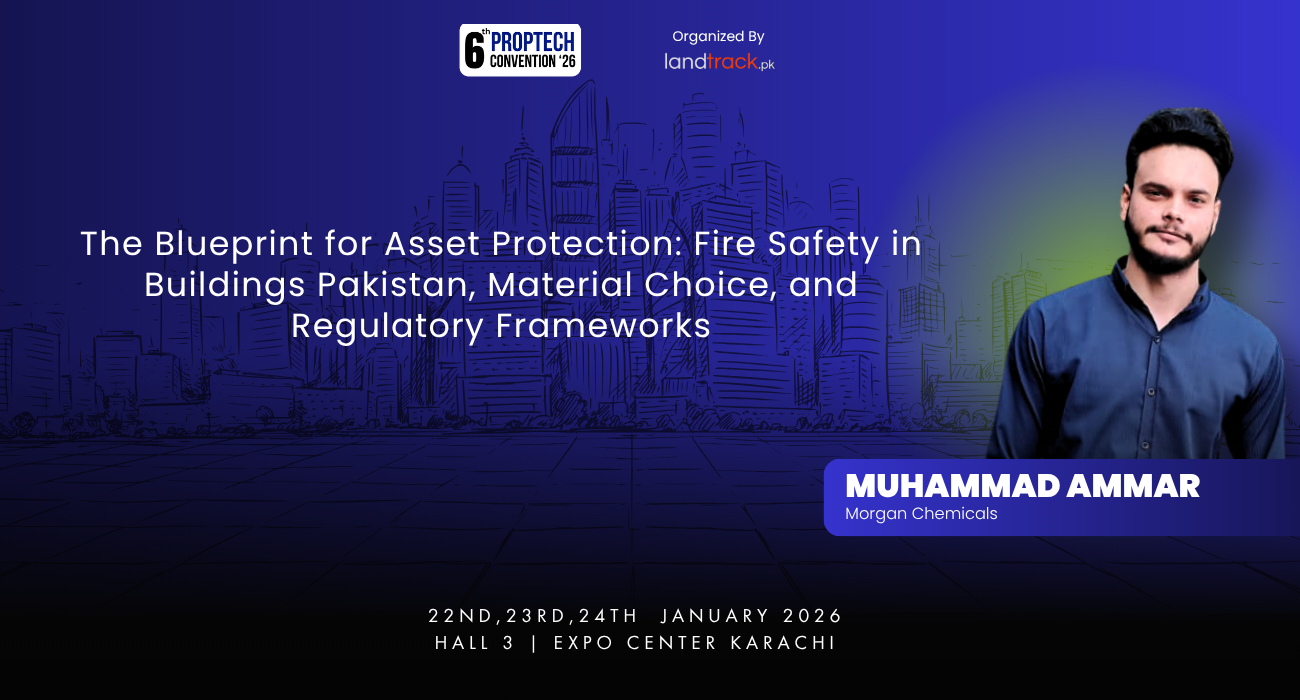
Modern real estate valuation is directly linked to risk mitigation. As highlighted by industrial experts like Muhammad Ammar from Morgan Chemical at the PropTechConvention2026, integrating advanced fire safety systems is no longer a redundant operational expense—it is a core real estate investment that safeguards human lives, preserves long-term asset value, and insulates developers from immense financial liability.
Building resilient structures requires a deep understanding of three interconnected pillars: the Building Code of Pakistan, strategic Material Choice, and advanced engineering solutions like halogen-free solutions.
1. The National Legislative Framework: Building Code of Pakistan
The baseline for engineering design across the country is the Building Code of Pakistan (BCP) – Fire Safety Provisions 2016. Developed through a joint initiative by the Pakistan Engineering Council (PEC) and the National Disaster Management Authority (NDMA), this document serves as the primary legal standard for structural fire defense.
Legal Mandates and Compliance Timelines
Legalized under S.R.O. 1073 (I)/2016 and S.R.O. 1074 (I)/2016, the code is benchmarked directly against the international NFPA 1 (2015) standards. Under this federal framework, ignoring fire safety guidelines is classified as a direct violation of professional engineering works, exposing engineers and developers to severe penalties.
The Building Code of Pakistan Fire Safety Provisions establishes clear timelines for structural compliance:
New Construction: Any structure permitted after November 2016 must achieve immediate compliance regarding material selection, exit layouts, and fire suppression systems.
Existing Structures: Older commercial, industrial, and high-density residential facilities were granted a maximum window of three years (ending in November 2019) to complete full structural retrofits.
Immediate Life Safety Systems: Core emergency systems—including smoke detection networks, localized fire alarms, portable extinguishers, and standardized evacuation plans—were mandated to be fully operational within twelve months of the initial notification.
Engineering Parameters of the BCP 2016
The code moves beyond broad safety ideas, establishing strict rules for physical building layouts. It defines structural classifications from Types I through V, mapping precise maximum travel distances to exits, dictating the installation of automated smoke control networks, and requiring pressurized emergency stairwells. Furthermore, high-occupancy structures must incorporate isolated emergency command centers with a minimum floor area of 96 ft2 to coordinate first-response operations during a structural crisis.
2. Regional Enforcement Shifts and Provincial Adjustments
While the national framework provides technical benchmarks, provincial authorities adapt these rules to address local building densities and historical enforcement gaps.
Sindh Building Control Authority (SBCA) 2026 Amendments
In response to a catastrophic commercial fire at Gul Plaza in Karachi that resulted in 73 fatalities, the Sindh Building Control Authority enacted the Karachi Building and Town Planning Regulations (Amendment) 2026. Enacted under Section 21-A of the Sindh Building Control Ordinance, 1979, these amendments have fundamentally altered the landscape of KarachiRealEstate by making fire protection infrastructure a non-negotiable part of both project planning and final completion stages.
According to the official Dawn News SBCA Report, the 2026 regional updates introduce several critical technical requirements:
Dedicated Water Storage: Buildings must feature completely separate underground and overhead water storage tanks reserved exclusively for firefighting infrastructure.
Certified MEP Drawings: Project approval is halted unless certified Mechanical, Electrical, and Plumbing (MEP) blueprints are reviewed and signed by registered professional engineers.
Inter-Departmental Clearances: Final building completion plans will not be approved without written No Objection Certificates (NOCs) from both the municipal Fire Brigade and the Civil Defence Department.
Establishment-Level Equipment: Commercial retail outlets must house a minimum of one fire extinguisher per shop, while larger department stores must provide at least one unit for every 400 square feet of covered area.
Parking Access Reform: To prevent vehicle congestion from blocking emergency access routes, developers are required to expand vehicle allocations, adding a mandatory 16% space buffer dedicated to motorcycles and bicycles.
Provincial Emergency Service (Rescue 1122) Regulations
Outside of Sindh, municipal enforcement is driven by local regulations, such as the Punjab Community Safety Buildings Regulations. These directives focus heavily on outdoor safety systems, mandating external red pillar-type fire hydrants equipped with dual 2.5-inch outlets. For structures up to 100 feet in height, internal overhead water tanks must maintain a minimum capacity of 7,500 gallons. Crucially, to allow heavy firefighting vehicles to move without obstruction, all primary access roads serving new developments must maintain a minimum clear width of thirty feet.
3. Hidden Fire Risks: Materials, Costs, and Conduit Hazards
A major threat to ConstructionSafety in Pakistan is systematic cost-cutting during the procurement phase. Developers frequently lower short-term expenses by purchasing substandard electrical, architectural, and mechanical components, inadvertently creating severe long-term hazards.
The Perils of Low-Grade PVC Cabling
Electrical wiring is often the primary source of ignition during overcurrent events, voltage fluctuations, or short circuits. Standard, low-cost electrical cables are insulated with basic Polyvinyl Chloride (PVC). Under high thermal stress, the chlorinated polymer base of PVC undergoes a chemical process called dehydrochlorination. This reaction releases a dense black smoke alongside toxic hydrogen chloride (HCl) gas.
When HCl gas contacts moisture within the human respiratory tract, it instantly forms a corrosive hydrochloric acid solution. Statistics show that approximately 70% of fire fatalities in Pakistani commercial, industrial, and residential sectors are caused by toxic smoke inhalation and rapid asphyxiation rather than direct thermal burns. The toxic smoke cuts down visibility, disorients occupants, and traps them within the structure.
HVAC and Service Shaft Vulnerabilities
Beyond wiring, heating, ventilation, and air conditioning (HVAC) systems can accelerate the spread of a fire. If air ducts cross multiple floors without automatic fire dampers, they act as pathways that distribute toxic gases throughout the building. Furthermore, using non-fire-retardant materials for duct insulation, ceilings, paneling, or external cladding allows flames to easily bypass structural fire barriers, turning standard utility shafts into chimneys that spread fire rapidly across floors.
4. Advanced Material Choice: Halogen-Free Flame Retardants
To improve FirePrevention and protect building assets, the manufacturing sector is moving away from halogenated plastics toward HalogenFree, FlameRetardant compounding. High-performance wire and cable insulation relies on endothermic mineral additives to suppress combustion safely. Through partnerships with international manufacturers like Huber Advanced Materials, local distributors are supplying high-purity Aluminium Hydroxide (ATH, marketed as Martinal) and Magnesium Hydroxide (MDH, marketed as Magnifin) to Pakistani cable manufacturers.
Chemical and Thermodynamic Mechanisms
ATH and MDH work by absorbing thermal energy and releasing water vapor to suppress the fire. However, their thermal properties dictate how they are used with different polymer matrices:
| Parameter / Mineral Property | Martinal (Aluminium Hydroxide / ATH) | Magnifin (Magnesium Hydroxide / MDH) |
|---|---|---|
| Chemical Formula | Al(OH)3 MD | Mg(OH)2 MD |
| Mineral Structure | Hydrargillite MD | Regular Crystallite (Brucite) MD |
| Thermal Decomposition | Initiates at ≈ 200°C MD | Highly stable up to 320°C – 340°C MD |
| Endothermic Enthalpy | 1051 J/g of compound MD | 1316 J/g of compound MD |
| By-Product Release | 34.5% Water Vapor MD | 31.0% Water Vapor MD |
| Matrix Compatibility | Plasticized/Unplasticized PVC, EVA, Elastomers MD | Polyamides, Polyolefins (PE, PP), EPDM, Silicone Rubber MD+ 1 |
Aluminium Hydroxide decomposes at approximately 200°C according to the following endothermic reaction:
2Al(OH)3 —— Δ ≥ 200°C → Al2O3 + 3H2O
This process absorbs 1051 J/g of heat energy, cooling the polymer matrix. The released water vapor dilutes combustible gases and displaces oxygen near the flame. Concurrently, it forms an aluminum oxide (Al2O3) char layer on the surface, which insulates the remaining plastic, blocks oxygen access, and traps soot particles.
For high-temperature engineering plastics like polyamides or polyolefins, Magnesium Hydroxide is required because it remains stable up to 340°C:
Mg(OH)2 —— Δ ≥ 320°C → MgO + H2O
MDH absorbs 1316 J/g of heat and leaves a protective magnesium oxide (MgO) layer that delays ignition and reduces peak heat release rates.
Surface Coating Engineering
To preserve the tensile strength and flexibility of cable insulation, these minerals must be uniformly dispersed throughout the polymer matrix. Uncoated minerals tend to clump, which degrades the mechanical properties of the cable. Specialized surface treatments resolve this issue:
Vinyl-Silane Coatings: Improve compatibility with cross-linked polyethylene (XLPE), allowing chemical bonding during extrusion.
Fatty Acid Coatings: Act as processing aids, improving material flow and elongation in thermoplastic materials like EVA.
Amino-Silane Coatings: Designed for polar polymers like polyamides to maintain high tensile strength under mechanical stress.
5. International Cable Performance and Smoke Control Standards
To achieve certified safety compliance in SmartConstruction and SustainableBuilding projects, materials must pass rigorous testing protocols outlined by the International Electrotechnical Commission (IEC). More technical details on these metrics can be found in the Lapp APAC Halogen-Free Guide.
Halogen Content Evaluation (IEC 60754-1): Insulation materials undergo high-temperature combustion in a tube furnace. To pass, the absolute concentration of halogen acid gas must not exceed 0.5% or 5 mg/g of the sample.
Acidity and Conductivity Testing (IEC 60754-2): Vapors from the burning insulation are bubbled through an aqueous solution. The solution must maintain a minimum pH of 4.3 and an electrical conductivity below 10 μS/mm. This ensures the smoke will not corrode sensitive electronics or cause severe respiratory damage to occupants.
Smoke Density Photometrics (IEC 61034-2): Cable samples are burned inside a sealed 27 m3 chamber while a light-beam system measures smoke density. Light transmittance must remain at or above 60% to ensure escape routes remain visible during an evacuation.
Critical Circuit Survivability (IEC 60331-21 / -25): Evaluates the cable’s ability to maintain electrical and structural integrity under direct flame exposure. Cables must function continuously for a minimum of 90 minutes (Part 21) or 180 minutes (Part 25) to ensure backup lighting, emergency alarms, and fire pumps remain operational during a crisis.
6. Strategic Recommendations for the Pakistan Real Estate Lifecycle
Adopting a proactive approach to safety transforms fire protection from a regulatory burden into a high-yield real estate strategy that minimizes risk and stabilizes long-term asset value.
For Regulatory Agencies and Municipal Authorities
Enforce Codes Strictly: Building control authorities and cantonment administrations must strictly enforce the BCP Fire Safety Provisions 2016, treating violations as professional engineering breaches under the PEC Act 1975.
Conduct Regular Safety Audits: Local authorities should perform routine inspections of existing commercial high-rises to ensure emergency exits are unlocked, fire paths are clear of unrated wiring, and fire barriers are properly maintained.
For Architects, Real Estate Developers, and MEP Designers
Integrate Safety Early: Incorporate smoke control systems, pressurized egress pathways, and fire compartmentalization directly into the initial architectural design phase.
Install Dedicated Fire Tanks: Ensure all plumbing blueprints include separate water storage tanks reserved exclusively for firefighting systems, matching the SBCA 2026 mandates.
Specify HFFR Materials: Mandate the use of flame-resistant materials and HFFR/FRNC cabling compliant with IEC standards for all critical service shafts, emergency circuits, and high-occupancy zones.
For Cable and Polymer Manufacturers
Upgrade Extrusion Lines: Transition compounding lines toward non-halogenated matrices (such as EVA or XLPE) modified with high-purity, coated ATH or MDH additives.
Secure Independent Certifications: Obtain third-party validation for low-smoke, zero-halogen, and fire-resistant products to support the growing demand for verified safety materials in RealEstatePakistan and CommercialRealEstate developments.
Frequently Asked Questions
What are the core requirements of the Building Code of Pakistan for fire safety?
The Building Code of Pakistan (BCP) 2016 mandates strict construction classifications, maximum exit travel distances, automated smoke control systems, pressurized emergency stairwells, and isolated emergency command centers. It applies immediately to new builds, while existing structures must be retrofitted within three years.
Why are halogen-free solutions critical for smart construction?
Halogen-free solutions are critical because they do not release toxic hydrogen chloride gas when exposed to high temperatures. This prevents the formation of corrosive acids, protecting human respiratory tissue during evacuations and safeguarding expensive electronics or structural steel from degradation.
How do the SBCA 2026 amendments impact KarachiRealEstate projects?
The Karachi Building and Town Planning Regulations (Amendment) 2026 make fire safety infrastructure a mandatory part of planning. Developers must provide dedicated firefighting water storage, certified MEP drawings, shop-level fire extinguishers, and expanded motorcycle parking to prevent emergency vehicle congestion.
What is the difference between ATH and MDH in flame-retardant materials?
Aluminium Hydroxide (ATH) initiates endothermic decomposition at ≈200∘C and suits polymers like PVC or EVA. Magnesium Hydroxide (MDH) remains thermally stable up to 340∘C , making it ideal for engineering plastics like polyamides and polyolefins that require high extrusion temperatures.
What international standards define low-smoke cable compliance?
Key standards include IEC 60754-1 (halogen content $<0.5\%$) , IEC 60754-2 (acid emissions $\text{pH} \ge 4.3$) , and IEC 61034-2 (minimum smoke light transmittance of $60\%$). These tests ensure that escape routes remain visible and non-toxic during building evacuations.
Why is circuit survivability under IEC 60331 important for high-rises?
IEC 60331-21/-25 certifies that critical cables maintain electrical integrity under direct flame for 90 to 180 minutes. This survival window is necessary to keep emergency power, backup lighting, communications, and firefighting water pump systems functioning during a crisi
How does poor material choice increase hidden fire risks in construction?
Cost-cutting often leads to using low-grade PVC cabling and non-fire-retardant duct insulation. This allows standard utility shafts to act as chimneys , rapidly spreading dense black smoke, toxic gases, and flames across floors while blocking occupant evacuation paths.
Why is fire safety considered a real estate investment rather than an expense?
High-performance fire safety systems turn risk into value. Using certified flame-resistant materials minimizes liability, protects long-term structural value, lowers insurance premiums, and ensures full compliance with local building authorities.