

Pakistan’s metropolitan centers are caught in a striking economic contradiction. Capital injection into the real estate sector is at an all-time high; developers are selling out vertical projects rapidly, proptech innovations like real estate fractionalization coins are emerging, and the commercial co-working footprint expands daily . Yet, the macroeconomic and civic realities of these cities paint a grim picture. From systemic transit collapses to escalating environmental hazards—evidenced by multiple catastrophic building fires in Karachi over a short span and chronic infrastructural deficiencies on vital arteries like University Road—the urban fabric is fraying .
This systemic misalignment answers a critical question confronting institutional investors, policymakers, and urban planners: Why are Pakistan’s cities falling behind despite rapid construction growth?
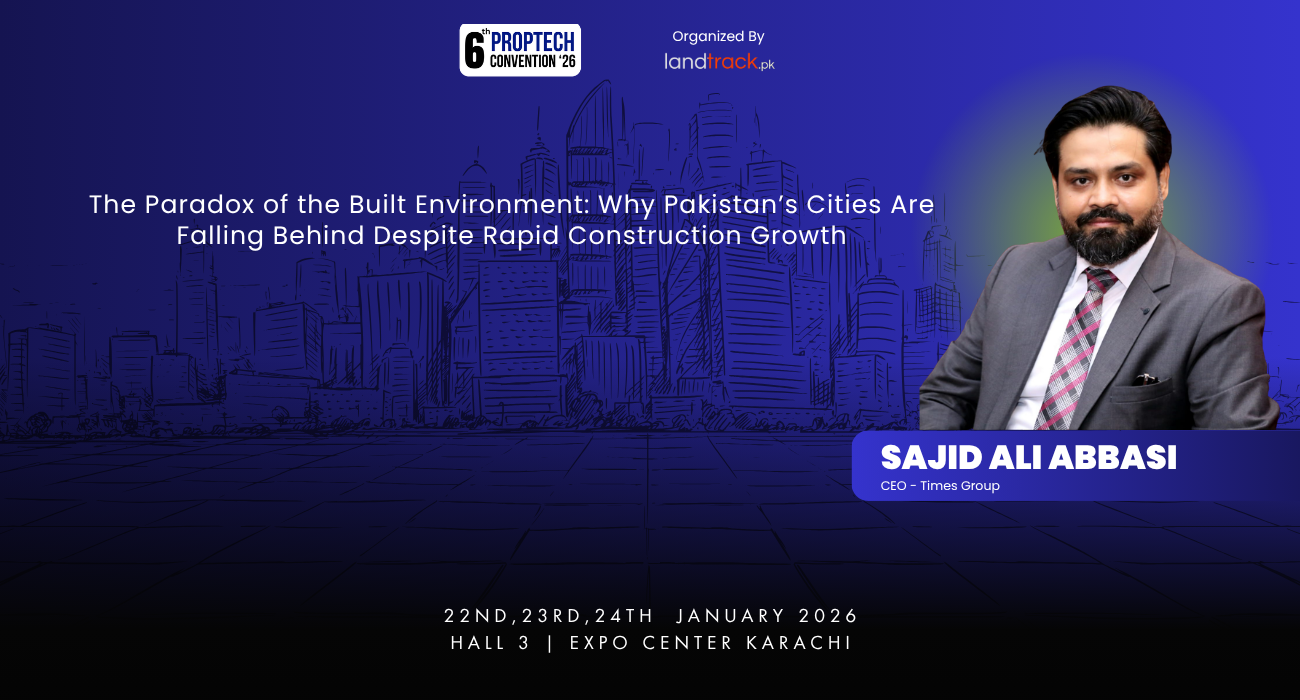
At the PropTech Convention & Expo, Sajid Ali Abbasi, Times Group CEO, delivered a sobering diagnosis of this crisis. The core issue is that Pakistan’s real estate industry is fundamentally conflating “isolated project construction” with “holistic city building”. To salvage the economic viability of the country’s urban centers, the market must pivot away from a short-term, cost-driven construction paradigm and embrace the principles of value-based macro-planning.
1. The Silo Trap: Project Isolation vs. Unified Urban Vision
The primary driver behind the failure of Pakistani urban spaces is the systemic practice of building real estate assets in regulatory and geographic isolation. Municipalities have historically treated urban expansion as a collection of independent parcels rather than an integrated, living system .
When developers secure isolated approvals without evaluating regional zone demands, spatial distortion occurs . Cities become fragmented networks of high-end enclaves—such as DHA, Clifton, Gulshan, and Nazimabad—juxtaposed against underserved, dense settlements . This ad-hoc clustering breeds distinct socio-economic silos, effectively preventing the development of a unified urban blueprint .
Sajid Ali Abbasi emphasized that Pakistan is building isolated projects rather than coherent cities. Without a unified, macro-level urban vision, our major hubs are deteriorating into fragmented “silos” that completely break down civic cohesion.
According to an Express Tribune analysis on urban governance deficiencies, treating infrastructure developments merely as isolated engineering tasks rather than comprehensive governance projects costs the national economy between 4% and 6% of its GDP annually. Without a continuous, macro-level urban framework, even substantial foreign or multilateral investments face logistical bottlenecks that diminish their long-term value .
2. Moving From Cost Savings to Value-Based Cities
The real estate sector remains highly vulnerable to a transactional “cost-based mindset trap”. Developers frequently prioritize minimal upfront capital expenditures ($\text{CapEx}$) over the long-term operational expenditures ($\text{OpEx}$) of a building .
The Cost-Based vs. Value-Based Paradigm * Cost-Based Mindset: Focuses entirely on immediate asset margins, deploying repetitive or sub-standard designs to maximize short-term profitability . * Value-Based Cities Concept: Views structural quality, baseline material standards, and spatial safety protocols as critical capital investments that preserve regional wealth across generations .
Shifting toward Value-Based Cities does not imply unnecessary gold-plating or luxury over-specification. Instead, it means recognizing that choosing cheaper components—such as low-grade electrical wiring, inadequate corridor widths, or compromised fire escapes—creates significant future liabilities . When short-term savings compromise structural integrity, iconic urban hubs can transform into dangerous structural liabilities within a couple of decades.
The speaker challenged the industry’s obsession with short-term cheapness, defining high-quality materials not as a baseline expense, but as a long-term investment. Skimping on foundational infrastructure creates massive, dangerous liabilities 20 to 30 years down the line.
3. The Missing Equation: Lifecycle Thinking in Asset Management
A major operational vulnerability in the domestic ecosystem is the complete absence of Lifecycle Thinking. In mature global markets, the completion of a building marks the beginning of an extensive asset management lifecycle. In Pakistan, the relationship between the developer and the structure often ends abruptly post-possession .
This post-construction abandonment explains why hundreds of multi-story structures across major urban hubs are officially classified as hazardous. When public welfare and preventative maintenance are ignored, buildings designed to last 60 to 70 years suffer severe degradation in less than 20 years .
Furthermore, the domestic industry lacks functional performance feedback loops. Architects and structural engineers rarely record or analyze empirical post-occupancy data regarding elevator wear, facade weathering, or water pump performance in high-rise developments . As a result, technical flaws are routinely copied across subsequent projects, eliminating opportunities for design innovation .
Sajid Ali Abbasi pointed out that Karachi currently has between 600 and 700 critically dangerous buildings. This structural crisis exists because developers completely abandon assets post-construction, ignoring lifecycle maintenance and failing to gather data on how high-rise projects actually perform.
4. Fragmented Infrastructure and the Breakdown of Land Zoning
The structural failures of large Pakistani cities are tied directly to an unbalanced distribution of spatial real estate values. The construction cost variance between elite sub-markets and peripheral districts is often minimal . However, the stark disparity in land valuations forces mass cost-cutting in mid-to-low-tier developments, which accelerates the decline of regional infrastructure quality .
This disparity is compounded by structural flaws in local land zoning. Uncoordinated zoning models split major cities into strict, segregated residential and commercial nodes . This arrangement forces entire populations to migrate along a single directional axis every morning and evening, resulting in severe traffic congestion and public transit bottlenecks .
Our cities are suffering under flawed land zoning. Because commercial and residential zones are poorly integrated, the entire population travels in one direction at 9 AM and reverses at 5 PM, creating forced traffic congestion and fracturing our utility networks.
As documented in The Express Tribune liveability index data, a lack of synchronized utility mapping and basic municipal infrastructure leaves major cities highly vulnerable to recurring environmental challenges. When civic entities operate in data isolation, basic public safety measures like open drainage management, water security, and road maintenance break down completely .
5. Transitioning to Smart Cities Pakistan: The Role of PropTech and Data Systems
To build sustainable urban environments, technology must be used as a core planning tool rather than just a digital sales mechanism . True Smart Cities Pakistan require a foundational digital infrastructure where data transparency and cross-departmental accountability drive planning decisions .
Implementing property technology (PropTech) solutions at the municipal governance level offers major institutional benefits:
Centralized Digital Master Plans: Overcoming historical planning failures, such as those highlighted in The Express Tribune report on the Greater Karachi Regional Plan 2047, requires moving beyond static, theoretical frameworks and adopting live, data-driven single-window planning systems.
Life-Cycle Performance Capturing: Using IoT sensors and building management software allows developers and municipal authorities to monitor structural integrity and utility use in real-time.
Cross-Agency Data Governance: Breaking down institutional silos enables transparent data sharing, which improves tracking of water availability, waste distribution, and power consumption .
By leveraging technology to track historical performance metrics, the real estate sector can transition from speculative transaction models toward an economic framework based on transparent, long-term urban capital appreciation . As detailed in an Express Tribune study on spatialisation and urban capital, modernizing real estate governance is essential for attracting international institutional capital into domestic urban economies.
Technology cannot substitute for a coherent urban vision; it is a tool to execute it. Real PropTech integration means introducing a centralized ‘One-Window’ digital approval system that records cross-agency data, forces transparency, and builds public trust.
Summary: Designing a Legacy-Driven Blueprint
Cities are not merely configurations of concrete, steel, mortar, and brick . They are highly complex, interdependent systems shaped by the repetitive decisions made by their institutional stakeholders . If the local industry continues to prioritize rapid construction growth over structural longevity and value-based integration, urban productivity will keep declining.
Reversing this urban decline requires developers, architects, and regulators to adopt a long-term perspective focused on regional legacy . Real estate development should be approached as a multi-generational responsibility. By enforcing rigorous performance metrics, utilizing integrated data systems, and shifting focus toward long-term asset value, Pakistan can develop cities that serve as sustainable engines of macroeconomic growth .
Frequently Asked Questions
Why are Pakistan’s cities falling behind despite rapid construction growth?
Cities fail because developers build isolated real estate projects instead of integrated urban systems. Without a unified master plan, high construction volume only creates fragmented municipal silos .
What is the difference between cost-based construction and value-based cities?
Cost-based construction limits focus to immediate upfront expenditures ($\text{CapEx}$) and short-term margins. Value-based cities treat structural quality and safety as long-term investments that protect generational wealth.
How does fragmented infrastructure hurt property ROI in Pakistan?
When utilities, roads, and spatial zoning are uncoordinated, rapid asset deterioration occurs. This structural decline devalues neighborhoods, turning multi-million rupee investments into liabilities within decades.
What is Lifecycle Thinking in real estate development?
Lifecycle Thinking is an asset management strategy that focuses on a building’s performance and operational costs ($\text{OpEx}$) over a 50-to-70-year lifespan, rather than abandoning the project immediately after sale .
Why do Pakistani high-rises suffer from severe design repetition?
The real estate ecosystem lacks functional feedback loops. Architects and developers rarely capture post-occupancy performance data, meaning identical engineering and cultural flaws are duplicated across projects .
How does flawed land zoning cause traffic congestion in Karachi?
Strict segregation of massive residential enclaves from commercial hubs forces the entire population to commute along a single axis at the exact same times, overwhelming the transit network .
What did Sajid Ali Abbasi reveal about dangerous buildings at PropTech 2026?
The Times Group CEO revealed that Karachi alone faces a massive crisis with 600 to 700 critically dangerous buildings, driven directly by a lack of preventative maintenance post-possession .
Why are modern PropTech innovations like fractional coins failing to save urban infrastructure?
Technology is a tool to execute a strategy, not a substitute for a vision . Digital sales tools increase investment liquidity but do not fix underlying zoning violations or systemic utility fragmentations .
How can a "One-Window" digital system improve Pakistani smart cities?
A centralized digital approval platform forces data sharing across municipal agencies . This transparency establishes data logs for utilities and populations, driving institutional accountability .
What is legacy thinking in real estate macroeconomics?
Legacy thinking requires stakeholders to build for the next generation and ethical accountability rather than rapid, short-term liquidity, ensuring projects sustainably support the urban economy .