

Pakistan’s startup ecosystem is standing at a brutal, unforgiving intersection. We possess one of the world’s most staggering demographic advantages—over 67% of our population is under the age of 30. Developed nations like Japan look at our youth-heavy demographic profile with pure envy. Yet, despite having unprecedented access to world-class AI models, decentralized frameworks, and global open-source tech, our entrepreneurial engine routinely stalls.
The harsh reality is that most Pakistani startups fail long before they hit a scaling crunch. They fail because our ecosystem is plagued by a fundamental misalignment of execution, capital allocation, and builder psychology.
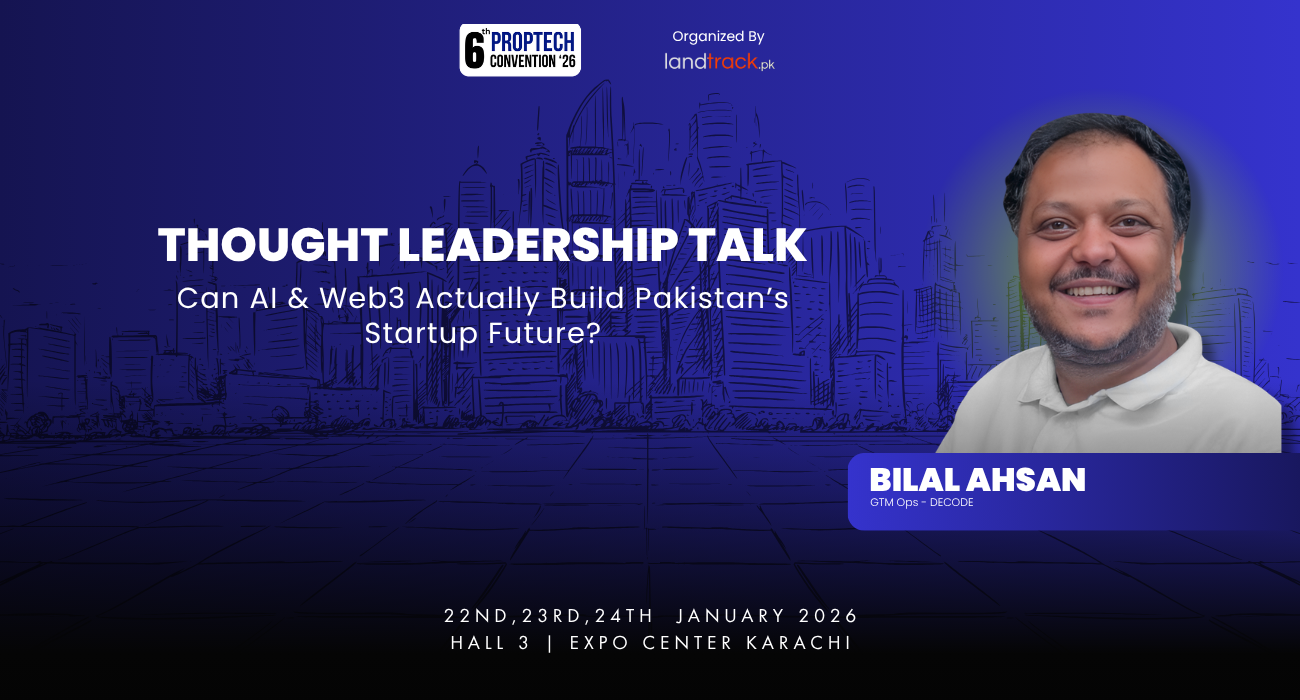
At the PropTech Convention 2026 in Karachi, Bilal Ahsan Elahi—a Chartered Accountant turned elite global Web3 growth strategist and founder of the give-back campaign Decode—dropped an unfiltered, high-stakes keynote that cut right through the ecosystem’s noise. Elahi challenged the core philosophy of contemporary tech adoption, asking a pivotal question: Can AI & Web3 Actually Build Pakistan’s Startup Future?
The answer isn’t found in raising bloated seed rounds or hiding behind sophisticated tech jargon. It requires an aggressive, structural shift in how we build, monetize, and launch products.
1. The Commodity Trap: Why Code is No Longer Your Competitive Advantage
For the past decade, technical execution—writing clean code, spinning up databases, managing servers—served as a primary barrier to entry for software startups. Founders with technical capabilities held a natural monopoly over those without.
Today, that barrier has entirely collapsed.
“Today, tech is just a commodity. Tech is no longer ‘tech’. AI writes the code and AI improves it. So what will we do? We will simply give it the right commands.” — Bilal Ahsan Elahi
If an AI engine can generate a functional software architecture, optimize backend queries, and debug lines of code in seconds, then your software stack is no longer an economic moat. It is a baseline utility.
Moving Beyond the “AI Consumer” Mindset
Many self-proclaimed AI Startups in Pakistan are merely wrapping basic API calls around existing Large Language Models (LLMs) and calling it innovation. This is not building; it is advanced consumption.
To survive in an ecosystem where technical execution is commoditized, founders must move away from the “garbage in, garbage out” pipeline. The value has shifted completely from the lines of code written to the system flows designed. Founders must possess deep domain expertise to orchestrate how these automated tools solve structural real-world problems. To accelerate your technical workflows and move beyond simple consumer tools, developers can explore open-source artificial intelligence systems and pre-trained models on Hugging Face Open Source AI Repositories.
2. Demystifying Web3: Adding Floors, Not Replacing Foundations
The term Web3 frequently triggers two extreme reactions in the local tech space: uncritical hype or immediate skepticism tied to regulatory caution. Both perspectives miss the structural reality of decentralized technologies.
Web3 is not a radical, isolated paradigm that requires discarding decades of proven internet architecture. Instead, it represents an evolutionary upgrade.
As Elahi noted during his keynote, transitioning to Web3 isn’t about erecting an entirely new building from scratch; it’s about constructing a new floor on top of an existing, functional foundation. If you are already building a data architecture, managing a supply chain ledger, or developing real estate tokenization frameworks, Web3 simply adds an advanced layer of transparency, sovereign ownership, and global liquidity.
For Pakistani builders to leverage this shift, they must stop treating Web3 as an abstract sandbox and start applying their existing engineering, database, and business logic directly to decentralized networks. For structural decentralization guidelines and protocol standards, builders can review smart contract security frameworks via the Ethereum Developer Documentation Hub.
3. The Non-Complex Solution Model: How to Build for Real Monetization
A glaring issue in Pakistan’s entrepreneurial landscape is the pursuit of complex, convoluted business models that fail to answer a foundational question: Who is going to pay for this?
If your primary objective is to build sustainable value and drive revenue, your immediate focus must shift toward radical simplicity. The most direct path to commercial viability is the Non-Complex Solution Model:
The Non-Complex Solution Framework
Identify the Friction Point: Isolate a clear, visible problem that real people or businesses actively face.
Strip Away Technical Complexity: Design a solution that eliminates technical friction for the end user rather than introducing new hurdles.
Build for Longevity: Focus on long-term utility and structural problem-solving rather than chasing short-term, speculative trends.
If you can deliver a non-complex solution to a widespread problem, the monetization strategy resolves itself. Instead of building abstract platforms looking for a problem, target systemic inefficiencies—such as logistics bottlenecks, cross-border payment friction, or opaque supply chains—and deploy targeted AI workflows to resolve them cleanly. To build a resilient corporate foundation that sustains this focus, learn how to align long-term organizational goals using the Harvard Business Review Strategy Guides.
4. The Growth Blueprint: Master a Global GTM Strategy
A flawless product without a distribution engine will fail every single time. One of the most critical deficiencies in the local ecosystem is a sophisticated, battle-tested GTM Strategy Pakistan framework. Local startups frequently over-invest in early product development while severely under-indexing on distribution, positioning, and market entry dynamics.
To transition from a localized pilot to a scalable, internationally competitive product, founders must master the mechanics of a modern Go-To-Market framework:
Design Rigorous System Flows: Before writing code, chart the exact user journey, operational dependencies, and value delivery mechanisms.
Run Global GTM Playbooks: Look past localized target markets from day one. Structure your product, pricing, and compliance pipelines to serve global enterprise clients or international retail user bases.
Shift from Consumer to Builder Psychology: Stop using international platforms purely as digital consumers. If a digital format or platform format is highly successful, analyze its core engagement loop and build localized, sovereign variations or superior alternatives tailored for high-growth economic corridors.
5. Overcoming the Market Density Myth: The Network Effect
A common psychological roadblock among Pakistani entrepreneurs is the fear of immediate competition. When an enterprise launches a successful model, neighboring founders often view it as a zero-sum threat to their survival rather than a market validation signal.
This defensive mindset actively stifles ecosystem velocity.
Consider how physical commercial districts thrive: a single textiles vendor has limited reach, but an entire cluster of vendors creates a dedicated market that draws buyers from across the region.
The digital tech ecosystem operates under identical laws of market density. We do not need fewer startups competing for a fixed pie; we need an explosion of complementary builders clustering together to establish a robust, globally recognizable marketplace. High density drives shared talent pools, attracts institutional venture capital, forces rapid product iterations, and accelerates collective infrastructure development. To benchmark structural growth metrics against international competitors and track regional funding flows, founders can analyze emerging market capitalization updates on the Crunchbase Global Venture Capital Database.
6. Shifting the Founder Mindset: Stop Being Consumers
Pakistan cannot spend its way out of an economic transition by remaining a passive consumer of global technology. Our reliance on importing digital tools without producing sovereign intellectual property leaves our ecosystem highly vulnerable to shifting global dynamics.
The transformation requires an intentional, cultural shift toward an aggressive Founder Mindset:
Cease Time-Wasting Habits: Reallocate cognitive bandwidth away from passive digital consumption and redirect it toward building high-utility systems.
Build Through Bootstrapping: Relying on external venture capital to validate a basic business hypothesis can be a dangerous trap. Start building out of pocket, leverage open-source tools, prove your unit economics early, and maintain raw, capital-efficient operational agility.
Commit to Ecosystem Reinvestment: True market leaders don’t operate in silos. They actively share technical insights, host localized developer meetups, and open-source non-core components to elevate the technical capabilities of the entire community.
Pakistan’s tech ecosystem is rapidly shedding its legacy image on the global stage. The country’s top developers, founders, and technical minds are systematically establishing their presence in international forums and proving their execution capabilities. But scaling this momentum requires every single builder to play their part in the broader intersection of technology and economic growth.
The technical toolset is completely democratized. The underlying infrastructure is accessible. The demographic runway is ready. The ultimate success of Pakistan’s startup future rests entirely on whether our builders choose to stop consuming technology and finally start engineering the solutions to our most critical problems.
Frequently Asked Questions
Can AI & Web3 actually build Pakistan’s startup future?
Yes. AI and Web3 democratize access to advanced technical development and global financial networks. By leveraging AI to automate coding and utilizing Web3 to create transparent, cross-border digital architectures, Pakistani startups can bypass legacy infrastructure bottlenecks and compete directly on the global stage.
Why does Bilal Ahsan Elahi state that tech is just a commodity?
With the rapid evolution of advanced generative AI systems, writing, debugging, and optimizing software code can now be handled autonomously by machines. Because technical execution is no longer an expensive barrier to entry, the software stack itself has become a baseline utility rather than an economic moat.
What is the Non-Complex Solution Model for startup monetization?
The Non-Complex Solution Model focuses on identifying a clear, widespread real-world friction point and building a straightforward, highly accessible solution that eliminates complexity for the end user. Stripping away unnecessary engineering overhead allows startups to establish clear utility and drive sustainable monetization.
How should a Pakistani founder approach a global GTM Strategy?
Founders must build with a global perspective from day one. This requires moving away from purely localized use cases, designing highly structured system flows that can scale across international borders, and structuring products to address universal enterprise or consumer problems
What does the phrase "Web3 is just a new floor on the tech building" mean?
It means Web3 is a natural architectural evolution of the internet rather than a complete replacement of it. Instead of throwing away existing web applications and databases, builders simply integrate a new decentralized layer focused on trust, transparency, data ownership, and smart contract automation on top of their existing stacks.
Why is market density beneficial for competing tech startups in Pakistan?
Market density creates a vibrant, concentrated ecosystem. When multiple startups launch in the same vertical, they collectively validate the market, attract international venture capital, draw in specialized engineering talent, and accelerate the development of shared infrastructure.
How can local founders move from an AI consumer mindset to an AI builder mindset?
Instead of wrapping basic interfaces around existing API calls, founders must use deep domain expertise to build proprietary system flows. True AI builders use these automated tools to orchestrate comprehensive, long-term technical solutions for complex structural inefficiencies.
What is the give-back campaign Decode mentioned in the keynote?
Decode is a self-funded initiative launched by Bilal Ahsan Elahi and his team to deliver educational insights, foster community collaboration, and host builder meetups across major cities like Karachi and Islamabad. The initiative aims to empower Pakistani developers to stop being mere consumers and start building scalable technology.
What demographic advantage does Pakistan hold for tech adoption?
Pakistan possesses an immense demographic advantage with over 67% of its total population under the age of 30. This massive, digitally native demographic provides an unparalleled talent pool for engineering, scaling, and adopting advanced AI and Web3 frameworks.
Why is bootstrapping valuable for early-stage tech startups?
Bootstrapping forces founders to remain capital-efficient, maintain lean operations, and validate their product-market fit using real revenue rather than speculative venture funding. Operating with out-of-pocket agility ensures the startup focuses entirely on solving sustainable, long-term problems.