

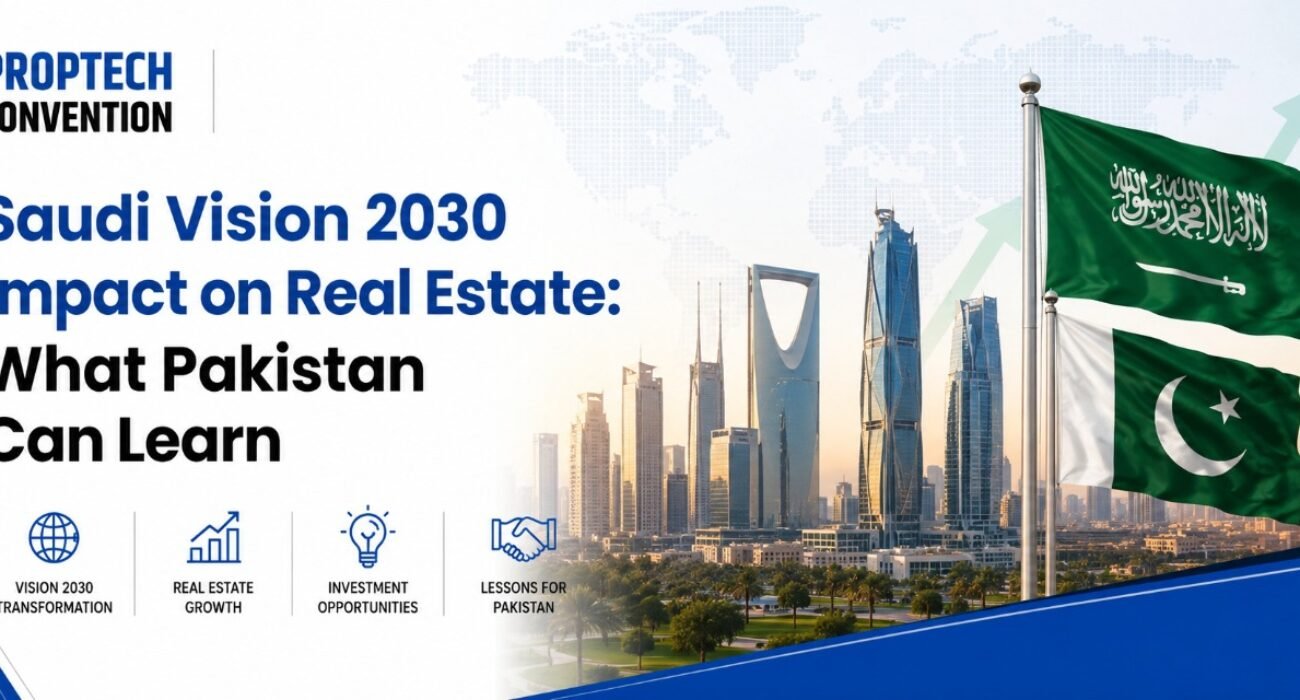
The Sovereign Architectural Shift: Re-Engineering Real Estate into a Macroeconomic Engine
Emergent economies have historically treated real estate as an unbanked, illiquid store of private capital characterized by informal file trading, opaque title registries, and speculative land banking. The restructuring of the Saudi Arabian real estate market under Saudi Vision 2030 represents a departure from this traditional model. Instead of treating real estate as a passive byproduct of urban growth, the Kingdom has re-engineered the sector into a primary driver of non-oil Gross Domestic Product (GDP) growth, private sector capital formation, and institutional wealth creation. Driven by a state-led asset-class transformation, the total valuation of the Saudi real estate sector currently exceeds SAR 4 trillion (~USD 1.1 trillion).
Saudi Arabia Real Estate Macroeconomic Re-Engineering Framework
| Strategic Layer | Policy Mechanism | Operational Metric | Target Economic Value |
| Regulatory Consolidation | REGA Sector Strategy & Statutory Laws | Unified governance across 13 provinces | Eliminate market fragmentation & tax leaks |
| Digital Spatial Cadastre | Real Estate Registry (RER) spatial mapping | 85% land parcel registration targeted by 2029 | Guarantee title indefeasibility & stop property fraud |
| Demand-Side Liquidity | Sakani Platform & SRC Mortgage Refinance | Homeownership rate expansion to 66.24% | Expand homeownership & deepen banking assets |
| Sovereign Supply Masterplanning | ROSHN PIF Horizontal Infrastructure Funding | 400,000+ turn-key residential units | Prevent land hyperinflation & build 15-minute cities |
This structural realignment relies on synchronized policy execution across regulatory centralization, spatial cadastral mapping, secondary mortgage refinance mechanisms, and institutional supply creation. A key milestone within this strategic vision is the targeted trajectory for Vision 2030 saudi development, which seeks to expand the real estate sector’s contribution to national GDP to SAR 316.16 billion while generating over 456,000 highly skilled jobs by 2030.
For policy makers, urban developers, and institutional investors in South Asia, analyzing the Saudi Vision 2030 real estate impact provides an instructive playbook for structural reform. Pakistan’s real estate sector—valued between USD 300 billion and USD 400 billion—remains constrained by overlapping municipal jurisdictions, paper-based revenue records, informal file-trading networks, and a deep deficit of institutional trust. By evaluating how the Saudi Vision 2030 Official Portal translates sovereign mandates into statutory enforceability , Pakistan can build an execution roadmap to transition its property market from a speculative tax haven into an institutionalized asset class.
Macro-Structural Governance: REGA’s Comprehensive Strategy vs. Pakistan’s Municipal Fragmentation
The foundation of Saudi Arabia’s real estate restructuring is Council of Ministers Resolution No. 252, which approved the Comprehensive Strategy for the Real Estate Sector executed by the Real Estate General Authority (REGA). REGA abolished the fragmented, multi-agency regulatory structure that previously governed Saudi land administration, replacing it with a centralized governance model anchored across four strategic pillars:
Sector Governance: Formulating unified statutory legislation, standardizing licensing requirements for brokerage and facility management, and deploying compliance oversight mechanisms across all administrative provinces.
Empowerment and Sustainability: Standardizing asset valuation methodologies, professionalizing local practitioners through the Saudi Real Estate Institute, and implementing pre- and post-development sustainability standards.
Market Efficiency: Accelerating absolute title registration, modernizing off-plan sales frameworks (Wafi program), and establishing transparent pathways for international capital.
Partners Service: Centralizing dispute resolution through real estate committees, digitizing partner services, and deploying data transparency platforms to enforce transactional indefeasibility.
Comparing Saudi Arabia’s REGA Framework vs. Pakistan’s Fragmented Municipal Regulations
| Regulatory Dimension | Saudi Arabia (REGA Unified Framework) | Pakistan (Fragmented Municipal Ecosystem) | Strategic Policy Translation |
| Institutional Oversight | Single national authority (REGA) governing legislation, licensing, registration, and enforcement. | Fragmented across CDA, LDA, SBCA, Cantonment Boards, and local housing societies. | Establish a Federal Real Estate Regulatory Authority (RERA) to unify municipal bylaws. |
| Title Registration & Cadastre | Absolute, indefeasible title issued via spatial parcel registry (RER) managed digitally. | Deed-based manual registry system (Patwari system) prone to double allocations. | Mandate GIS-linked cadastral mapping with mandatory spatial parcel IDs. |
| Off-Plan Development Safeguards | Strict escrow bank requirements and milestone audit controls under the Wafi program. | Unregulated off-plan “file trading” with unapproved layout plans and cash over-selling. | Prohibit plot file transfers without mandatory bank-held escrow accounts. |
| Foreign Investor Onboarding | Rule-based digital onboarding via unified portals (Saudi Properties Platform / MISA). | Ad-hoc, manual NOC checks across multiple security agencies and local land registries. | Implement a single-window digital portal tied to RDA for foreign and diaspora buyers. |
In contrast to REGA’s unified model , Pakistan’s urban real estate market is fractured across competing municipal agencies, provincial boards of revenue, cantonments, and private development authorities. This jurisdictional friction inflates compliance costs, creates legal ambiguities in land title enforcement, and enables unapproved housing schemes to trade undocumented plot files. To modernize urban hubs like Sindh, Punjab, and the federal territory, municipal authorities must look to initiatives like the Karachi Vision 2030 urban plan to centralize developer licensing, mandate escrow controls on off-plan projects, and eliminate arbitrary paper documentation.
Demand Aggregation & Institutional Supply: The Sakani, ROSHN, and Mortgage Refinance Triad
Solving a national housing deficit requires aligning subsidized retail demand with institutional, scalable developer supply. In 2016, Saudi Arabia faced a domestic homeownership rate of just 47%. To achieve the Vision 2030 target of 70% homeownership, the state launched a dual-track strategy combining digital demand aggregation via Sakani with sovereign master-community delivery via ROSHN.
Sovereign Housing Triad Implementation Matrix
| Triad Entity | Sovereign Role | Operational Mechanism | Key Performance Metrics |
| Sakani Platform (Demand Aggregator) | Single digital front door for national housing access | Consolidates eligibility checks, profit subsidies, and title assignment | Homeownership increased to 65.4% (2024) and 66.24% (2025) |
| SRC & SAMA (Liquidity Engine) | Secondary mortgage purchase & macroprudential easing | SAMA LTV relaxed (85% to 90%); SRC purchases bank mortgage portfolios | Secondary mortgage market expanded from SAR 117B to SAR 700B+ |
| ROSHN (Master Developer) | Sovereign supply creation (PIF Subsidiary) | Direct absorption of horizontal infrastructure costs for 15-min cities | Delivering 400,000+ turn-key master-planned residential units |
The Sakani Platform and Demand-Side Liquidity
Operated jointly by the Ministry of Municipalities and Housing Sakani Platform and the Real Estate Development Fund (REDF) , Sakani acts as the single digital front door for national housing access. Sakani eliminated inter-ministerial silos by consolidating eligibility checks, mortgage origination, subsidies, and title assignment into a unified digital user interface.
Sakani Demand Acceleration Flow
| Step | Process Stage | Policy Action | Economic Impact |
| 1 | Digital Onboarding | Single front door authentication via Sakani platform | Eliminates inter-ministerial bureaucracy |
| 2 | REDF Profit Subsidy | First SAR 500,000 of principal subsidized at 0% interest | Reduces monthly debt service burden for buyers |
| 3 | SAMA LTV Adjustment | Down payment requirement reduced from 10% to 5% | Lowers cash entry barriers for first-time buyers |
| 4 | SRC Liquidity Injection | SRC purchases mortgage portfolios from commercial banks | Recycles banking capital to sustain long-term lending |
Through this system, Saudi Arabia’s homeownership rate rose to 65.4% by end-2024 and reached 66.24% by end-2025 , demonstrating how digital integration can accelerate housing delivery.
Supply-Side Institutionalization via ROSHN
To prevent state-subsidized retail demand from causing hyperinflation in unimproved land, the Public Investment Fund (PIF) established ROSHN as the national master community developer. ROSHN uses long-term sovereign capital to absorb front-loaded horizontal infrastructure costs—such as arterial road networks, primary utility trunk lines, district cooling, and public parks—that often deter private developers. ROSHN then constructs integrated 15-minute walkable communities, introducing master-planned residential inventory (over 400,000 units planned nationwide) to match retail demand.
For Pakistan, where housing demand exceeds supply by over 10 million units, adopting this model requires replacing unverified, private plot file schemes with state-backed infrastructure developers that build turn-key residential communities.
Deconstructing the Foreign Property Ownership Framework & Statutory Mechanics
On January 21, 2026, Saudi Arabia enacted Royal Decree No. M/14 (The Law of Real Estate Ownership by Non-Saudis), repealing its 2000 foreign ownership framework. Supported by Implementing Regulations approved via Council of Ministers Decision No. 43 on June 23, 2026 , the law replaces ad-hoc ministerial permissions with a transparent, rules-based foreign investment architecture.
Matrix of Foreign Ownership Pathways Under Saudi Arabia’s Framework
| Target Investor Category | Designated Access Portal | Legal Scope & Geographic Privileges | Mandatory Onboarding & Disclosure Rules | Transactional Taxes & Penalty Regime |
| Natural Non-Resident Persons | Saudi Properties Platform (REGA) | Freehold ownership or usufruct rights up to 99 years within designated Geographic Zones. Excludes Makkah & Madinah. | National Digital ID (Nafath/Iqama), local bank account, local KSA phone line. Commercial subletting prohibited. | 2% REGA Fee (Prime Zones) + 5% RETT (7% Total). Up to 5% fine or forced sale for misrepresentation. |
| Foreign-Incorporated Enterprises | Invest Saudi (MISA) & REGA Portal | Ownership permitted inside Geographical Zones for commercial, industrial, or residential project development. | MISA Investment License, complete UBO chain disclosure, registered local KSA representative. | RETT (5%) + REGA Disposal Fee (2%). Up to SAR 1,000,000 fine for unnotified corporate changes (>5% UBO). |
| Saudi Unlisted Companies (with Foreign Shareholders) | Ministry of Commerce & REGA | Classified as Domestic Entities. Permitted to buy inside Geographical Zones and outside (with MISA clearance). | Standard Commercial Registration (CR), disclosure of shareholder ownership structures. | Standard RETT (5%) and applicable municipal fees. Multi-tiered administrative fines for non-compliance. |
| Capital Market Vehicles (REITs, Listed Firms, SPEs) | Saudi Stock Exchange (Tadawul) / CMA | Full market access across KSA, including Makkah & Madinah via fund units or listed equity (<49% foreign ownership). | CMA-licensed fund manager oversight, institutional investor qualification under QFI/SIF rules. | Market transaction fees; exempt from direct individual property acquisition taxes. |
Under this statutory reform, Foreign ownership Saudi Arabia policies explicitly differentiate between direct land title ownership and indirect capital market participation. A key operational pillar of the reform is the digital property process, which routes registration, beneficial ownership verification, title issuance, and tax payments through a unified REGA interface integrated with SAMA payment rails.
For international firms operating in the Kingdom, partnering with local partners real estate KSA or utilizing established local partners real estate saudia arab corporate channels allows unlisted Saudi-incorporated entities to acquire operational assets outside designated zones while retaining legal protections.
Makkah Vision 2030 & The Holy Cities Sovereign Sub-Regime
The real estate transformation of Makkah and Madinah operates under a sovereign framework designed to balance economic modernization with constitutional protections for holy sites. Driven by the Pilgrim Experience Program—a pillar of Makkah Vision 2030 targeting 30 million annual Umrah performers and 6 million Hajj pilgrims by 2030 —the Holy Cities are attracting significant infrastructure and real estate investments.
Makkah & Madinah Investment Access Corridors
| Investment Pathway | Target Investor Eligibility | Geographic Scope & Asset Types | Regulatory Restrictions | Approved Legal Ownership Vehicle |
| Direct Title / Usufruct Pathway | Non-Saudi Muslim Individuals Only | Freehold & Usufruct up to 99 years within REGA Geographic Zones | Categorically excludes non-Muslim foreign individuals | Direct Title Deed registered via REGA / RER Portal |
| Capital Markets & Corporate Pathway | Global Investors (Muslim & Non-Muslim) | Commercial, hospitality, retail, and mixed-use developments | Subject to CMA fund caps (<49% aggregate foreign equity) | Tadawul-Listed REITs, Closed-End Funds & Saudi JVs |
| Corporate Joint-Venture Access | Global & Local Enterprise JVs | Strategic hospitality & infrastructure projects | Subject to MISA licensing & UBO compliance | Saudi Unlisted Companies (Non-Saudi Shareholders) |
Under the foreign ownership law, direct freehold ownership and usufruct rights within the administrative borders of Makkah and Madinah are strictly reserved for Muslim individuals. Non-Muslim foreign natural persons are excluded from direct land title ownership within the Holy Cities. However, institutional capital access is permitted via Capital Market Authority (CMA) regulated vehicles. International investors, regardless of religious background, can acquire financial exposure to prime hospitality, retail, and mixed-use developments in Makkah and Madinah by subscribing to Tadawul-listed REITs, licensed real estate funds, or Special Purpose Entities (SPEs) that own property assets in the Holy Cities.
Makkah & Madinah Strategic Master Developments
| Master-Planned Destination | Developer / Sovereign Sponsor | Project Valuation & Scope | Target Inventory & Infrastructure | Approved Regulatory Ownership Channels |
| Masar Destination (Makkah) | Umm Alqura for Development and Construction (UAQ / PIF) | SAR 63 Billion master plan (SAR 38B+ capital committed). | 24,000 hotel rooms, 13,000 residential units, 19,000 serviced apartments. | Muslim individuals (direct title/usufruct); CMA-regulated real estate funds & Saudi corporate entities. |
| Thakher Makkah (Makkah) | Thakher Development & Al Rajhi Capital | USD 7 Billion development budget. | 42,000 hotel rooms, high-density residential towers, integrated retail centers. | Non-Saudi Muslim individual buyers ; global retail and institutional capital via CMA investment funds. |
| Rua Al Madinah (Madinah) | Rua Al Madinah Holding Company (PIF) | Mega-scale urban transformation project. | 80,000 hotel rooms, 500 residential units, 63% open green spaces. | CMA-licensed investment fund structures, public REIT subscriptions, Saudi corporate JVs. |
| King Salman Gateway (Makkah) | Sovereign Master Plan (Crown Prince Directive) | 12 Million sqm mixed-use urban corridor adjacent to Haram. | 50,000 residential units, 16,000 luxury hotel rooms. | Muslim diaspora buyers via REGA digital portal ; institutional investors via capital market vehicles. |
The real estate development occurring under Makkah Vision 2030 initiatives highlights how high-density infrastructure corridors can convert religious tourism into long-term real estate asset value.
Eradicating Fraud & Capital Market Integration: Policy Roadmap for Pakistan
To reform its property market, Pakistan needs to transition from legacy paper documentation and speculative file trading toward spatial digital registries and institutional capital market structures.
Policy Translation Execution Sequence for Pakistan
| Phase | Policy Initiative | Operational Target | Sovereign Outcome |
| Phase 1 | Spatial Cadastral Survey | Drone & GIS satellite baseline mapping | Replaces manual paper Patwari records |
| Phase 2 | Digital Title Registry (RER) | State-guaranteed indefeasible title issuance | Links land parcels to owner CNIC/NICOP |
| Phase 3 | Wafi Escrow Framework | Mandatory bank-held project escrows | Prohibits unapproved off-plan file sales |
| Phase 4 | SECP SIF & REIT Corridor | Private-placement Special Purpose Vehicles | Unlocks institutional diaspora equity |
Transitioning from Patwari Legacy Records to Digital Indefeasible Title
Pakistan’s current land administration relies heavily on manual, paper-based revenue records (Patwaris), leading to title ambiguities, duplicate allocations, land grabbing, and costly litigation. Efforts by provincial land record authorities—such as the Punjab Land Records Authority (PLRA)—have often digitized flawed manual paper records without spatial ground verification, preserving underlying errors.
Pakistan can learn from Saudi Arabia’s National Real Estate Registration Services Company (RER), a PIF-backed entity operating under REGA. The RER created a digital land registry by deploying spatial GIS mapping, drone imagery, and satellite surveys to establish an accurate “zero-zero” spatial baseline. Every real estate parcel is assigned a unique spatial identification number linked to the owner’s digital ID (Nafath), ensuring title indefeasibility.
Digital Title Verification Pipeline Comparison
| Verification Stage | Saudi RER Spatial Model | Legacy Pakistan Paper Model | Proposed Pakistan Reform Standard |
| Baseline Cadastre | Drone & satellite spatial GIS mapping | Manual Patwari paper cloth maps (Latha) | High-resolution satellite GIS survey |
| Title Deed Authentication | Nafath digital ID & instant parcel lookup | Physical paper deed (Fard) manual check | CNIC-linked digital title deed portal |
| Transfer Process | Instant bank-rail escrow title transfer | Physical court presence & revenue manual entry | Online biometrically verified transfer |
| Title Guarantee | Absolute state-guaranteed title indefeasibility | Deed-based recording prone to double sale | Statutory state title warranty act |
To achieve similar transparency, provincial authorities in Pakistan should suspend manual deed registration in urban centers and execute a spatial cadastral survey to issue indefeasible, state-guaranteed digital titles.
Capital Markets Reform: SECP REITs and the Overseas Diaspora Corridor
A key hurdle in attracting international capital to Pakistan’s real estate sector is the dominance of informal cash transactions and unregulated off-plan “file systems”. While the State Bank of Pakistan (SBP) introduced the Roshan Digital Account (RDA) and Roshan Apna Ghar initiatives to streamline foreign currency inflows from Overseas Pakistanis , the real estate investment process remains exposed to developer delivery risks, unapproved housing schemes, and capital repatriation hurdles.
To address these vulnerabilities, the Securities and Exchange Commission of Pakistan (SECP) can leverage lessons from the Saudi Capital Market Authority (CMA). The Saudi CMA expanded real estate capital formation by introducing Simplified Investment Funds (SIFs) and regulating Tadawul-listed REITs, which currently hold over SAR 50 billion in market capitalization.
Saudi CMA vs. Pakistan SECP Regulatory Framework Translation
| Regulatory Dimension | Saudi CMA Framework | Current SECP Framework | SECP Translation Strategy |
| Private Placement Vehicles | Simplified Investment Funds (SIFs) with flexible SPE structures | Complex RMC licensing (PKR 50M) and fund rules | Introduce Private-Placement SIF rules for accredited investors |
| Public Market Instruments | Listed REITs with mandatory 90% profit distribution | Nascent REIT listings on PSX | Exempt REITs from corporate double-taxation |
| Off-Plan Protection | Wafi certified escrow accounts and milestone releases | Informal advance cash collection by developers | Mandate trustee-managed escrow accounts |
To deepen domestic financial markets, the SECP should amend its Real Estate Investment Trust Regulations to create a simplified, private-placement institutional REIT corridor. This framework would allow accredited investors to pool capital into Special Purpose Vehicles (SPVs) for vertical developments under mandatory escrow and independent trustee oversight. Once operational, these assets can be converted into public REITs listed on the Pakistan Stock Exchange (PSX), giving overseas investors transparent, liquid real estate exposure.
For a detailed analysis of local market dynamics, review our comprehensive Pakistan real estate market analysis 2026, explore our Overseas Pakistani property investment guide, and examine the latest REITs in Pakistan and PropTech outlook.
Actionable Policy Execution Checklist for Pakistan
To modernize its property sector, Pakistan’s federal and provincial policy makers should execute the following steps:
Enact a Federal Real Estate Regulatory Act: Establish a central RERA modeled after Saudi Arabia’s REGA to unify licensing, developer compliance, and marketing approvals across all provinces.
Institute Mandatory Off-Plan Escrow Accounts (Wafi Framework): Ban the sale of unapproved plot files and require developers to deposit buyer funds into project-specific escrow accounts released only upon audited construction milestones.
Execute a National Spatial Cadastral Survey: Partner with space technology agencies and provincial land boards to map all urban property parcels, replacing manual Patwari paper registries with GIS-linked digital parcel numbers.
Formulate SECP Private-Placement SIF Rules: Amend REIT regulations to enable private institutional real estate funds, allowing developers to secure equity financing without relying on pre-sale cash flows.
Integrate RDA with Spatial Land Registries: Link State Bank of Pakistan banking channels directly with verified digital title databases, allowing overseas investors to execute property transfers online with guaranteed title security.
Strategic Synthesis
The transformation of Saudi Arabia’s real estate market under Saudi Vision 2030 shows how regulatory centralization, digital transparency, and capital market integration can convert property development into an economic growth engine. By establishing REGA , launching Sakani , founding ROSHN , and updating foreign ownership laws , the Kingdom built an institutional environment that protects investor capital and expands housing access.
For Pakistan, adopting these lessons offers a clear structural model. By replacing fragmented municipal administration with a unified regulatory framework , mapping land records using GIS technology , and developing institutional REIT structures , Pakistan can eliminate property fraud, attract diaspora capital, and build a modern, transparent real estate market.
Frequently Asked Questions
What is the main goal of Saudi Vision 2030 regarding homeownership and real estate?
The primary homeownership goal of Saudi Vision 2030 is to increase the national homeownership rate among Saudi citizens from its 2016 baseline of 47% to 70% by the year 2030. Managed through the Housing Program, this objective is supported by demand-side digital interventions such as the Sakani platform , regulatory adjustments by the Saudi Central Bank (SAMA) that expanded mortgage access , secondary mortgage market liquidity provided by the Saudi Real Estate Refinance Company (SRC) , and supply-side master community developments executed by ROSHN , successfully raising the national homeownership rate to 65.4% by end-2024 and 66.24% by end-2025.
How does Makkah Vision 2030 impact real estate development in the holy city?
Makkah Vision 2030 initiatives, executed under the Pilgrim Experience Program, aim to expand urban capacity to accommodate 30 million Umrah performers and 6 million Hajj pilgrims annually by 2030. This operational mandate has reshaped real estate development in Makkah by catalyzing high-density, multi-billion-dollar master-planned destinations such as Masar Destination (SAR 63 billion budget) , Thakher Makkah (USD 7 billion development cost) , and the King Salman Gateway (12 million square meters). These projects integrate transportation networks with hotel inventory, retail corridors, and serviced residential apartments , driving land value appreciation and attracting international institutional capital through Capital Market Authority (CMA) regulated investment vehicles.
What are the legal rules for foreign ownership in Saudi Arabia in 2026?
Effective January 21, 2026, Royal Decree No. M/14 (Law of Real Estate Ownership by Non-Saudis) and its Implementing Regulations (approved June 23, 2026) replaced case-by-case discretionary approvals with a transparent, rules-based framework. Non-Saudi natural persons can own freehold property or acquire long-term usufruct rights up to 99 years within officially designated Geographical Zones mapped by REGA, excluding the Holy Cities of Makkah and Madinah. Foreign-incorporated enterprises can buy property for business operations or development subject to MISA licensing , while Saudi-incorporated unlisted companies with foreign shareholders can purchase real estate across the Kingdom. Foreign capital access to Makkah and Madinah real estate is permitted through subscriptions to CMA-regulated listed REITs and investment funds.
How does the digital property process work under REGA in Saudi Arabia?
The digital property process under the Real Estate General Authority (REGA) centralizes property registration, title verification, tax payments, and title issuance onto a single platform operated alongside the National Real Estate Registration Services Company (RER). Applicants authenticate their identity using the national digital access portal (Nafath) , select a verified property tied to a unique GIS parcel ID , upload corporate disclosures or MISA licenses if applicable , pay the standardized 2% REGA disposal fee and 5% Real Estate Transaction Tax (RETT) via SAMA payment rails , and receive an indefeasible digital title deed, eliminating manual paperwork and physical title deeds.
What role do "local partners real estate KSA" play for international real estate businesses?
Skimping on fire safety systems (like sprinklers and proper electrical wiring) to save short-term capital creates massive long-term liabilities. Fully compliant buildings prevent asset depreciation via fire hazards, lower institutional insurance premiums, and secure premium investor capital.
How can Pakistan adopt Saudi Arabia's digital land registry model to prevent fraud?
Pakistan can eliminate systemic property fraud, land grabbing, and double allocations by transitioning from manual paper revenue records (Patwaris) to a unified, spatial digital registry modeled after Saudi Arabia’s Real Estate Registry (RER). Rather than scanning outdated paper documents into computerized databases , provincial authorities must conduct GIS cadastral surveys using satellite and drone mapping to create an accurate “zero-zero” land database. By assigning every land parcel a unique spatial identification number linked to the owner’s CNIC/NICOP and mandating digital title transfers, Pakistan can establish state-guaranteed title indefeasibility.
What can Pakistan learn from Saudi Arabia's ROSHN community development model?
Pakistan can adopt Saudi Arabia’s ROSHN model to shift its housing delivery from fragmented, speculative plot file trading toward institutional master-planned community development. By creating a state-backed master developer funded by patient sovereign or public-private capital , the government can absorb the heavy upfront costs of primary horizontal infrastructure—such as roads, water trunk lines, electricity grids, and sewerage treatment plants —before handing off parcel blocks to private developers. This ensures that housing supply consists of turn-key, integrated 15-minute walkable neighborhoods rather than undeveloped, unserviced suburban land plots.
How does REIT expansion in Saudi Arabia offer a roadmap for SECP reforms in Pakistan?
The expansion of Tadawul-listed REITs to over SAR 50 billion in market capitalization demonstrates how clear regulatory frameworks governed by the Saudi CMA can unlock institutional equity for real estate developments. The Securities and Exchange Commission of Pakistan (SECP) can reform its 2022 REIT Regulations by introducing a Simplified Investment Fund (SIF) framework for private placements , allowing accredited investors and funds to pool capital into Special Purpose Vehicles (SPVs) for early-stage vertical developments. These private funds can construct income-generating commercial and residential assets under escrow controls before listing them on the Pakistan Stock Exchange as public REITs, widening the retail investor base.
How do Saudi Vision 2030 reforms help attract overseas diaspora capital?
Saudi Vision 2030 reforms attract international and diaspora capital by replacing discretionary administrative approvals with rule-based digital onboarding, guaranteed title indefeasibility, and clear capital market investment channels. Non-resident investors can verify title deeds online, purchase units in master-planned developments through centralized digital portals, and invest in real estate funds with standardized tax and dividend distribution structures. For Pakistan, strengthening diaspora inflows through the State Bank of Pakistan’s Roshan Digital Account (RDA) requires linking bank remittance channels directly to verified spatial land registries and enforcing developer escrow accounts to ensure overseas capital is protected against project defaults.
What role does PropTech play in implementing Vision 2030 real estate initiatives?
PropTech serves as the core operational layer executing Saudi Vision 2030 real estate initiatives by linking government regulatory databases with investor-facing market portals. Platforms like Sakani streamline mortgage matching and subsidy allocation , the RER platform manages spatial cadastral mapping and indefeasible title issuance , and Wafi’s off-plan monitoring system uses digital verification tools to track construction progress and release escrow funds. PropTech transforms regulatory policies into efficient, transparent, and scalable real estate transactions across the Kingdom.