

Pakistan’s urbanization trajectory has outpaced its infrastructure. While official figures suggest that 39% of the population is urbanized, reports from the World Bank indicate that a staggering 88% of the nation’s populace is deeply dependent on urban centers for employment, energy, water, mobility, and security. For a megacity like Karachi, thriving in this high-density environment is no longer just about economic growth; it is fundamentally a matter of societal survival.
Addressing this reality requires a radical departure from legacy real estate practices. The traditional model of property development—buying a plot, constructing isolated block silos, and selling them off—has fractured urban landscapes into disconnected pockets. While Pakistan boasts large-scale, high-end gated communities with modern amenities, these remain isolated from the broader urban ecosystem.
The mandate for 2026 and beyond is the transition toward smart, intelligent buildings and fully integrated communities. By aligning with global standards, leveraging digital twins, and transforming property governance, megacities like Karachi can evolve from fragmented concrete jungles into sustainable, resilient smart cities.
Key Speaker Highlights & Core Takeaways
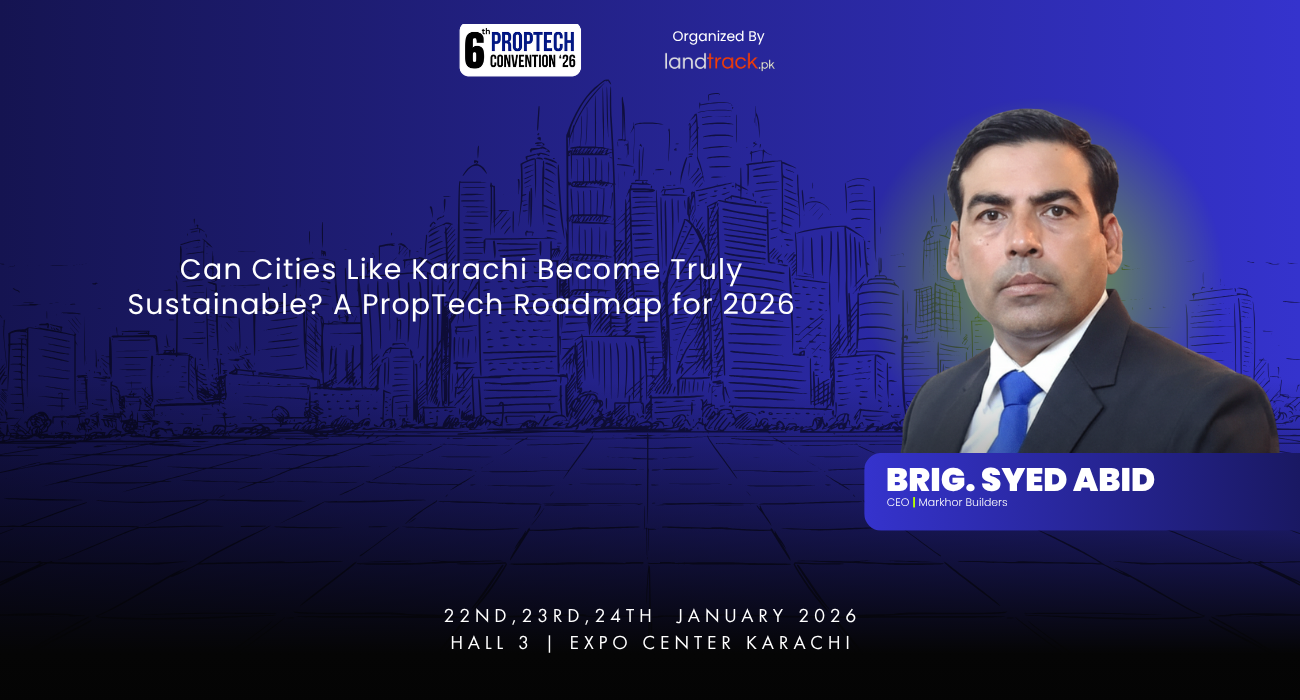
Keynote by Brig. Syed Abid at PropTech Convention 2026
During his address at the PropTech Convention 2026, Brig. Syed Abid outlined a transformative roadmap for urban sustainability, emphasizing the shift from isolated real estate development to integrated smart cities.
The Urban Dependency Reality: Despite official metrics citing 39%, the reality is that 88% of Pakistan’s population relies on urban infrastructure for essential survival, dictating a need for immediate systemic change.
Buildings as Living Organisms: Modern infrastructure must utilize IoT, sensors, and AI to act as a “living organism” that senses, adjusts, and responds to environmental data in real-time.
Energy Optimization: Integrating solar infrastructure with smart building controls and sensors can reduce current urban energy consumption by up to 30%, drastically lowering the carbon footprint.
Digital Land Governance: The most significant hurdle for builders and urban planners is the lack of authentic, digital land records. Linking property identities with central registries (like NADRA) is paramount for transparency and dispute resolution.
The Paradigm of Survival: In the modern urban era, “thriving is surviving.” Cities that fail to adopt integrated technologies will be left behind as historical footnotes.
Digital Twins and IoT: Engineering the “Living Building”
The foundation of a modern smart city rests on interoperable data. To align with global real estate standards, the concept of the “Little Smart City” relies heavily on the implementation of Digital Twins. This involves creating a real-time, data-based digital replica of physical infrastructure.
When physical assets are connected to their digital counterparts via the Internet of Things (IoT) and advanced sensors, the systems become fully integrated. As highlighted during the keynote address, this technological integration transforms a static building into a living organism capable of sensing its environment, adjusting parameters autonomously, and responding to changing conditions.
Global leaders have already demonstrated the viability of this model. Madrid, frequently cited as a top-tier smart city, has synchronized its AI, IoT, and city-wide systems to a single command center, allowing any localized urban event to be monitored and addressed instantaneously. Similarly, Dubai has successfully implemented streamlined e-permitting systems to accelerate compliant development. For Karachi to compete and sustain its population, local developers must adopt these data-driven frameworks in accordance with World Bank Urban Development guidelines.
Energy, Water, and Climate Resilience: The Pillars of Survival
Optimizing Energy and Water Grids
Energy sustainability is the first critical pillar for Pakistan’s urban future. Major corporations and government entities are increasingly producing energy, but the true efficiency lies in smart integration. By combining solar-based systems with intelligent optimization, smart controls, and IoT sensors within buildings, Karachi can achieve a 30% reduction in current energy usage. This strategy not only lowers utility burdens for individuals but crucially minimizes the national carbon footprint on a global scale.
Water scarcity is arguably an even more pressing threat, particularly for the residents of Karachi, who are acutely aware of the systemic failures in water distribution. Water is fast becoming the world’s most valuable asset. By regulating, saving, and intelligently managing water distribution networks through smart grids, the city can secure a sustainable future.
Combating Urban Heat Islands
The proliferation of concrete silos has exacerbated urban heat traps. Identifying these high-heat zones across Karachi and other Pakistani cities is a vital step in urban climate mitigation. Addressing this requires the strategic implementation of urban forestry. While the Sindh Government has launched successful green initiatives along the coastline, these environmental interventions must be deeply integrated into the city’s interior. Aligning such initiatives with UN-Habitat sustainability goals will be critical for long-term ecological balance.
Governance and PropTech: The Need for Digital Land Records
Beyond physical infrastructure, the sustainability of a city relies on transparent governance and interoperable administrative systems. According to insights shared at PropTech 2026, the single largest issue facing builders and real estate developers in Pakistan is the absence of authentic, digitized land records. This systemic flaw leads to severe law and order challenges and results in the imperfect delivery of housing schemes.
The roadmap for Pakistan’s real estate sector begins with fixing foundational documentation. A robust strategy requires integrating property records with a centralized database, such as NADRA. Just as individuals possess unique digital identities, every property must be assigned an immutable digital identity. Bridging these identities will create the transparency required to attract foreign and domestic capital, a priority often echoed by the Board of Investment Pakistan.
Traditional Real Estate vs. Smart City Development
| Feature | Traditional Model | PropTech Smart City Model |
| Development Style | Isolated plots and siloed block construction. | Fully integrated, interoperable communities. |
| Governance | Manual, disjointed, and dispute-prone land records. | Centralized digital identity linked to national databases (e.g., NADRA). |
| Energy Management | High-waste, static consumption. | 30% reduction via solar integration and smart IoT sensors. |
| Traffic Systems | Stereotype timer-based signals causing severe congestion. | AI-driven dynamic routing and optimized signal timing. |
AI-Driven Infrastructure and Cyber Resilience
Artificial Intelligence is no longer a luxury; existing without it has become practically impossible for modern urban centers. Karachi’s traffic management serves as a prime example of legacy inefficiency. Current “stereotype” traffic signals operate on fixed timers, often holding drivers at a red light on congested routes while granting green lights to entirely empty streets. This inefficiency actively encourages traffic violations and exacerbates urban congestion. By transitioning to AI-based traffic management, opening and closing times can be dynamically optimized based on real-time traffic flow, significantly reducing gridlock.
Furthermore, sustainability dictates resilience. Urban infrastructure must be built to withstand both natural calamities and human-driven disruptions. This requires embedding cybersecurity protocols and establishing Security Operations Centers (SOCs) to ensure citizens can conduct their daily lives safely and comfortably. Developing resilient infrastructure ensures compliance with safety codes dictated by bodies like the Sindh Building Control Authority.
Ultimately, urban development is a shared responsibility. The business community, particularly real estate builders, must focus on delivering human-centric societies rather than merely handing over isolated projects. The definition of survival has evolved. In 2026 and beyond, keeping pace with global technological integration is the only way for cities like Karachi to thrive because falling behind means fading into history.
Frequently Asked Questions
What percentage of Pakistan's population relies on urban infrastructure?
While official figures state 39%, World Bank reports indicate that up to 88% of Pakistan’s population relies on urban areas for employment, energy, water, mobility, and security.
What is the core problem with traditional real estate in Pakistan?
The traditional model focuses on buying plots and constructing isolated blocks or silos. This creates disconnected pockets of wealth rather than integrated, thriving cities.
What is a "Digital Twin" in PropTech?
A digital twin is a data-driven, technology-based virtual replica of physical infrastructure. It uses IoT and sensors to monitor and manage a building’s energy, maintenance, and services in real-time.
How can smart buildings reduce energy consumption?
By integrating solar-based systems with smart optimization, IoT controls, and real-time sensors, urban buildings can reduce their overall energy consumption by up to 30%.
How is water managed in a smart city model?
Water scarcity is a major threat. A smart city mitigates this by utilizing intelligent systems to regulate, save, and optimally distribute water, securing the city’s future resource needs.
What is the urban forestry initiative mentioned for Karachi?
The Sindh Government initiated urban forestry projects along the coastline to combat heat. Experts advise expanding these green initiatives inland into the city’s identified heat traps to reduce temperatures.
What is the biggest governance issue for builders in Karachi?
The lack of authentic, digitized land records is the most significant hurdle. It leads to law and order issues, imperfect housing delivery, and a lack of transparency in the real estate sector.
How can NADRA help stabilize Pakistan's real estate market?
By integrating land registries with NADRA, every property can be assigned a central digital identity linked to an individual, thereby eradicating fraudulent documentation and securing land records.
How can Artificial Intelligence improve Karachi's traffic?
Current fixed-timer traffic signals cause severe jams by holding cars at red lights while empty streets get green lights. AI-driven systems dynamically adjust signal timings based on real-time traffic flow.
What does it mean for a city to be "resilient"?
Urban resilience means designing infrastructure capable of withstanding both natural calamities and human-made disruptions, reinforced by robust cybersecurity and central Security Operations Centers.