

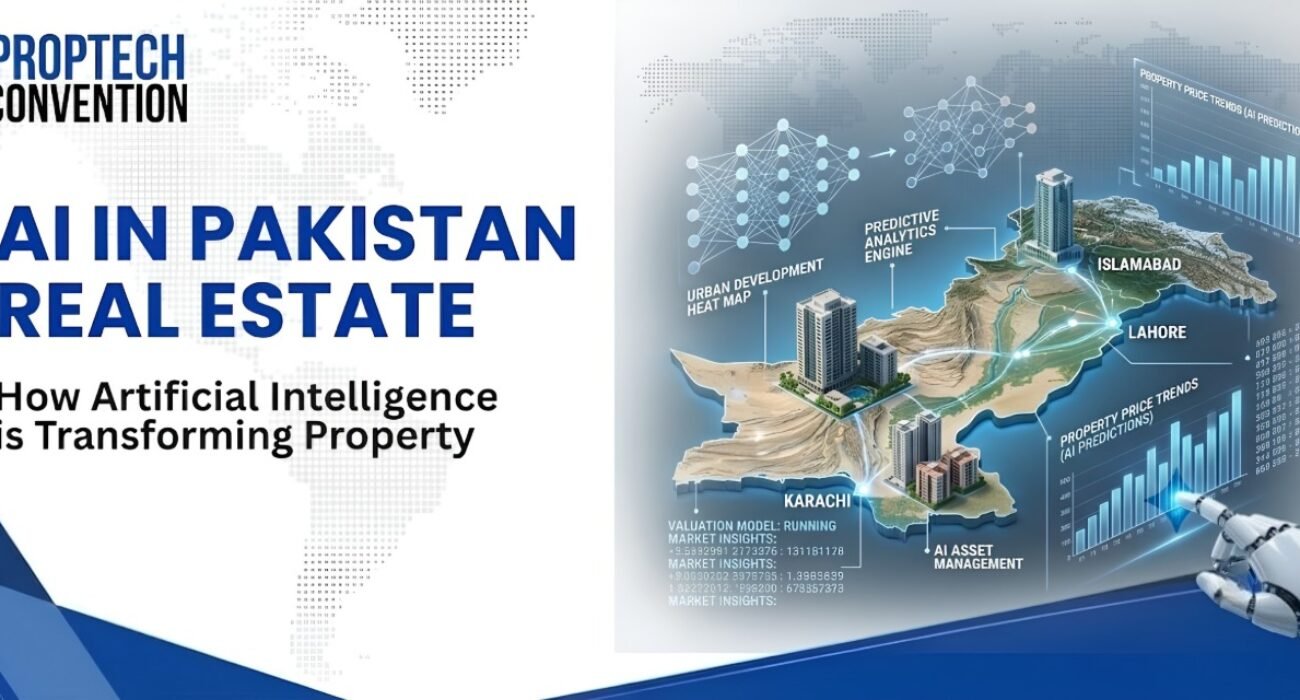
AI in Pakistan Real Estate: How Artificial Intelligence is Transforming Property
Data algorithms, machine learning models, and computer vision frameworks are systematically replacing traditional manual site operations and speculative guesswork across Pakistan’s built environment. For decades, the property market in metropolitan hubs like Karachi, Lahore, and Islamabad operated within an analogue, intuition-based paradigm characterized by opaque paper documentation, subjective manual valuation methods, and relationship-driven asset trading. Today, the landscape is undergoing a fundamental structural transition. By integrating advanced digital ecosystems, developers, institutional investors, and brokerage firms are shifting toward a highly deterministic, data-driven architecture.
This transformation is actively being deployed on heavy construction sites, within sophisticated CRM dashboards, and across distributed ledger land registries. Driven by the necessity to accommodate rapid urbanization, optimize capital allocation, and mitigate systemic fraud, industry leaders are realizing that relying on legacy systems is a strategic liability. As we examine the current state and trajectory of AI in Pakistan Real Estate, it becomes evident that artificial intelligence is no longer a peripheral novelty; it is the foundational infrastructure required to scale development, ensure strict regulatory compliance, and maximize investment yields in a volatile macroeconomic environment.
The Macroeconomic Context: Why Algorithmic Integration is an Operational Imperative
The economic contribution of the real estate and construction sector to Pakistan’s national Gross Domestic Product (GDP) has demonstrated steady, resilient growth, accelerating from 1.2% in 2020 to an estimated 2.0% in 2025. This sectoral expansion is paired with highly competitive residential and commercial rental yields, which hover around a national average of 6.24%—with Islamabad leading the demographic at 6.75% and Karachi closely following at 6.21%. However, scaling this growth to meet the demands of a population exceeding 240 million requires overcoming chronic systemic bottlenecks: fragmented land records, pervasive title fraud, extensive construction lifecycle delays, and inefficient, illiquid capital markets.
Digital transformation in real estate is the direct regulatory and commercial response to these entrenched inefficiencies. Institutional frameworks are rapidly adapting to support this technological pivot. With the federal government aiming to train over one million IT professionals by 2030, and regulatory bodies like the Securities and Exchange Commission of Pakistan (SECP) introducing sandbox licenses for digital assets and fractionalized property platforms, the foundational human capital and legal infrastructure for an AI-integrated property market are firmly established. The industry has reached a tipping point where the adoption of PropTech is the primary differentiator between tier-one market leaders and obsolete legacy firms.
AI-Powered Real Estate Valuation: The Rise of Automated Valuation Models (AVMs)
Historically, property valuation in Pakistan relied almost entirely on the subjective estimations of local property dealers and brokers. These manual appraisals often ignored the nuanced spatial heterogeneities, micro-economic shifts, and localized infrastructural developments that truly dictate market value. Today, the deployment of Automated Valuation Models (AVMs) is rendering these outdated manual appraisal systems obsolete, replacing them with scientific, algorithmic precision.
AVMs leverage complex machine learning algorithms—such as Extreme Gradient Boosting (XGBoost) and Light Gradient Boosting Machine (LGBM)—to ingest and analyze vast, unstructured datasets in real-time. By processing historical transaction records, current macroeconomic indicators, local demographic shifts, and even geospatial intelligence, these models deliver highly accurate, unbiased property assessments in a fraction of the time required for manual appraisals.
The Architecture of Intelligent Pricing
Leading the charge in this vertical are specialized PropTech development firms utilizing enterprise-grade artificial intelligence frameworks. For instance, solutions built on robust architectures like IBM Watsonx AI are fundamentally changing how physical assets are priced, traded, and leveraged. Platforms such as PureDesigners’ ValueSnap and Imarat’s Propmax.ai synthesize millions of data points to achieve unprecedented valuation accuracy, pushing the boundaries of what is possible in market forecasting.
Computer Vision and Spatial Analytics: Advanced AI models analyze visual data extracted from property photos, drone topography, and satellite imagery to identify structural defects, track neighborhood gentrification, and assess the quality of architectural finishes with up to 95% accuracy.
Spatial Heterogeneity Integration: Relying on Geographic Information Systems (GIS) and big data methodologies—similar to those rigorous frameworks outlined by the Pakistan Institute of Development Economics (PIDE) for Punjab’s urban property markets—AI models factor in localized anomalies. These include proximity to specific commercial zones, arterial road networks, mass transit nodes, and educational districts that traditional hedonic pricing models typically fail to quantify.
Quantifiable Operational Efficiency: Industry implementation data indicates that these AI-driven valuation models achieve a 94% accuracy rate (compared to a baseline of roughly 75% for manual dealer methods), facilitate 65% faster sales cycles by eliminating pricing friction, and drive a 50% reduction in operational appraisal costs.
For property developers and institutional portfolio managers, this capability translates to the power to instantly generate Automated Comparative Market Analyses (CMAs), forecast neighborhood price appreciation over a multi-year horizon, and calculate dynamic Return on Investment (ROI) profiles without waiting weeks for third-party manual appraisals.
AI-Powered Construction: Redefining Development Engineering and Site Operations
The integration of artificial intelligence is perhaps most physically tangible on the actual job site. AI-powered construction encompasses a comprehensive suite of hardware and software technologies designed to optimize the entire lifecycle of building development—from pre-construction generative architectural design to post-construction facility operations. In an environment where material costs are subject to severe inflationary pressure, optimizing construction logic is paramount for maintaining developer margins.
Generative Design and Building Information Modeling
At the core of modern mega-project development is BIM software (Building Information Modeling). According to comprehensive global industry analysis by research firms like MarketsandMarkets, AI is profoundly reshaping the BIM sector by transforming passive 3D CAD models into predictive, intelligent platforms. In Pakistan, forward-thinking ConTech (Construction Technology) firms and tier-one developers are utilizing 4D (schedule) and 5D (cost) BIM simulations to aggressively optimize structural engineering and project logistics.
Generative design algorithms allow architects and structural engineers to input specific spatial constraints, material cost limits, load-bearing requirements, and environmental factors into the software. The AI engine then rapidly computes thousands of architectural permutations, outputting the most cost-effective, structurally sound, and spatially optimized blueprints, drastically reducing the time spent in the drafting phase.
Robotics, Drones, and Autonomous Site Automation
The convergence of BIM data and robotics is rapidly accelerating AI-powered construction management across the country. Unmanned Aerial Vehicles (UAVs) equipped with LiDAR scanners and photogrammetry sensors conduct daily autonomous flights over sprawling development projects in Karachi’s Bahria Town, DHA City, and Lahore’s commercial zones.
These drones capture hyper-accurate, high-resolution topological data, which is instantly fed back into the central AI management system. The platform compares the “as-built” physical progress on the ground against the “as-designed” digital BIM models. If a concrete column is poured two inches off-axis, or if earthworks are deviating from the prescribed volume, the AI instantly flags the structural clash, alerting project managers and preventing catastrophic, costly downstream rework.
Traditional Construction vs. AI-Powered Construction in Pakistan
| Metric / Operation Phase | Traditional Construction Methodology | AI-Powered Construction Ecosystem | Quantifiable Efficiency Gain |
| Topological Site Surveying | Manual total stations and theodolites; requires weeks of field work. | Autonomous drone photogrammetry and LiDAR scanning; completed in hours. | 85% Reduction in Survey Time |
| Design Optimization | Sequential manual drafting; highly prone to human error and excess material waste. | Generative design algorithms via BIM software; thousands of permutations tested instantly. | 30% Reduction in Material Waste |
| Project & Supply Management | Disconnected Excel spreadsheets, fragmented WhatsApp communication, retroactive reporting. | Real-time predictive analytics, automated clash detection, dynamic 5D cost simulations. | 40% Reduction in Schedule Delays |
| Safety & Quality Inspection | Infrequent manual site walkthroughs; high risk of missed structural hazards. | Computer vision monitoring, IoT wearables, robotic safety inspections, continuous oversight. | 60% Decrease in Site Incidents |
Mitigating Fraud with Digital Verification and Distributed Ledger Technology
One of the most severe and persistent bottlenecks hindering both institutional and overseas foreign direct investment (FDI) in Pakistan has been the lack of title transparency. The archaic system of paper-based land registries (the “Patwari” system), fragmented layout plans (LOPs), and unverified Non-Objection Certificates (NOCs) has historically bred an environment ripe for real estate fraud in Pakistan.
Artificial intelligence, working in synergistic tandem with blockchain and Distributed Ledger Technology (DLT), is systematically dismantling these fraudulent frameworks. By establishing a cryptographically secure, immutable “Chain of Trust,” stakeholders can unequivocally guarantee the provenance, ownership history, and legal standing of a physical asset before any capital is deployed.
The Mechanism of Digital Verification
Modern digital verification ecosystems rely on highly sophisticated data aggregation and AI pattern recognition models. Domestic PropTech platforms utilize comprehensive Land Information Management Systems (LIMS) and Online Property Verification Systems (OPVS). These specialized tools seamlessly aggregate legal, spatial, and administrative data into a single, verified digital node.
Furthermore, machine learning algorithms are trained to detect minute anomalies in property documentation. By analyzing transactional patterns, verifying signature biometrics, cross-referencing CNIC databases, and tracing historical ownership claims, the AI system flags suspicious activity before capital changes hands. This is absolutely vital in preventing the notorious “NOC Trap,” where predatory developers use preliminary, unapproved layout plans to aggressively market and mislead buyers into purchasing plots in illegal housing societies.
Asset Tokenization and the Future of Real-World Assets (RWAs)
The powerful synergy of AI and blockchain real estate in Pakistan is culminating in the ultimate democratization of property ownership: asset tokenization. By fractionalizing a physical real estate asset—such as a commercial high-rise or a logistics warehouse—into programmable, digital smart contracts, the market becomes exponentially more liquid.
AI continuously manages the dynamic pricing of these tokens based on real-time market data and rental yield distributions, while the blockchain ensures immutable, transparent ownership records. This infrastructure not only lowers the barrier to entry for retail investors to own premium real estate but also provides unprecedented transparency and liquidity for overseas Pakistanis seeking secure, frictionless capital deployment in their home country.
Transforming Brokerages: ERP, CRM, and Lead Generation Automation
The traditional property dealer model—heavily reliant on physical diaries, scattered WhatsApp messages, fragmented Excel sheets, and memory—is mathematically incapable of scaling in today’s high-velocity, data-rich market. Enter the era of the modern, ai-powered real estate brokerage.
Comprehensive Enterprise Resource Planning (ERP) and Customer Relationship Management (CRM) tools tailored specifically for the nuances of the Pakistani market act as the central operating systems for forward-thinking agencies. These expansive platforms consolidate inventory tracking, financial ledger management, commission distribution, and customer relations into a single, unified, cloud-based command center.
Intelligent Lead Generation Automation and Web Scraping
The most critical competitive advantage provided by these centralized AI systems is lead generation automation. Advanced CRMs integrate natively with sophisticated data extraction tools (such as web scrapers provided by web data platforms like Apify) to continuously monitor competitor listings, scrape high-value pricing data from major property portals, and identify emerging consumer demand trends across different sectors.
Once a digital lead is captured through a social media campaign or organic search, the AI takes over the triage and qualification process:
Algorithmic Lead Scoring: The system analyzes a prospect’s digital footprint, their engagement duration with specific property links, and historical inquiry patterns to assign a highly accurate probability-to-close score. High-scoring leads are instantly routed to top-performing senior agents.
Dynamic Inventory Matching: The AI instantly cross-references the buyer’s stated budget, location preferences, and risk profile with the agency’s digitally verified inventory, presenting the human agent with the highest-probability matches before they even initiate the first phone call.
Landtrack.pk: Setting the Standard for AI Real Estate Automation
To balance human agency workflows with scalable client engagement, agencies are integrating specialized automation platforms. A leading example in the market is Landtrack.pk AI Chatbot Modules, built explicitly to optimize conversion funnels across Pakistan’s real estate sector.
Landtrack’s system replaces traditional auto-responders with an intelligent conversational model engineered to capture leads and drive closings around the clock. Offered through tailored Starter, Growth, and Pro tiers, their Growth Package provides real estate companies with up to 4,000 monthly automated interactions across WhatsApp Business, Instagram, Messenger, and website live chat. Trained directly on an agency’s property catalog and legal documentation, the AI handles complex client queries in natural language, shares rich media (such as floor plans, brochures, and video walkthroughs), and automatically logs prospect details into a centralized dashboard—ensuring sales teams focus strictly on high-intent prospects.
Predictive Analytics for Investment and Capital Market Forecasting
Capital allocation in real estate is no longer an exercise in speculative gambling or relying on the intuition of localized syndicates. Predictive analytics is empowering institutional investors, private equity firms, and major developers to map future demand, forecast macroeconomic market cycles, and calculate precise ROI before committing significant funds to land acquisition.
By analyzing massive, disparate datasets—including urban demographic shifts, infrastructure development blueprints, inflation rates, and historical price fluctuations—AI models can reliably predict which specific urban zones will experience the highest capital appreciation over a 5-to-10-year investment horizon.
This level of rigorous analytical capability is particularly crucial for sophisticated investors navigating the rapidly evolving real estate investment trust market (REITs) in Pakistan. AI-driven financial models continuously assess the viability of massive commercial and residential portfolios, stress-testing these assets against potential inflation spikes, interest rate hikes (KIBOR fluctuations), and localized supply gluts. The result is a highly defensive, data-backed investment strategy that systematically safeguards institutional capital against macroeconomic volatility and yields predictable, stabilized dividends.
Smart Building IoT: The Future of Post-Construction Facility Management
The profound utility of artificial intelligence does not simply terminate when the construction concludes and the keys are handed over to the buyer. In fact, the operational and maintenance phase of a building’s lifecycle represents the vast majority of its total long-term expenditures. To aggressively mitigate these ongoing operational costs, modern premium developments in Pakistan are increasingly being outfitted with comprehensive smart building IoT (Internet of Things) frameworks.
These intricate sensory networks create a live “digital twin” of the physical building. AI algorithms continuously ingest and monitor vast data streams from complex HVAC systems, structural load sensors, water flow meters, and internal electrical grids.
Predictive Maintenance: Rather than waiting for a critical elevator bank to break down or a primary water main to burst, the AI analyzes subtle vibration patterns and pressure data to predict mechanical failures weeks in advance, autonomously dispatching facility maintenance crews preemptively.
Dynamic Energy Optimization: Machine learning models study the daily occupancy patterns of a commercial high-rise or a residential complex, autonomously adjusting ambient lighting, heating, and cooling parameters in real-time to drastically minimize unnecessary energy consumption—a critical feature given Pakistan’s rising energy tariffs.
Asset Lifecycle Preservation: By ensuring that the physical asset operates at absolute peak mechanical and energetic efficiency, smart building IoT directly preserves the core capital value of the property. Buildings equipped with these AI integrations command premium rental yields from multinational corporate tenants who prioritize ESG (Environmental, Social, and Governance) sustainability and uninterrupted operational reliability.
Strategic Implementation Checklist for Developers, Agencies, and Investors
To survive and ultimately thrive in this rapidly encroaching data-driven landscape, real estate professionals across Pakistan must urgently transition from legacy operational habits to fully integrated PropTech ecosystems. The following granular checklist provides a structured, actionable roadmap for institutional technological adoption:
Audit and Migrate Existing Data Infrastructure: Immediately transition all highly vulnerable paper-based client records, manual financial ledgers, and fragmented property portfolios into a secure, encrypted, cloud-based ERP/CRM system.
Implement AVMs for Dynamic Inventory Pricing: Completely discard reliance on manual appraisals. Integrate a robust AI valuation API to ensure all listed properties are priced dynamically and aggressively according to real-time, localized market data.
Mandate 5D BIM for All New Developments: Require all contracted architectural and engineering partners to utilize 4D and 5D BIM software. Refuse to break ground on capital-intensive projects that rely solely on legacy 2D CAD drafting.
Deploy Drone Photogrammetry Protocols: Establish strict operational protocols for weekly UAV site inspections to feed “as-built” volumetric and spatial data back into the central project management AI, ensuring unyielding adherence to timelines and structural tolerances.
Enforce Uncompromising Digital Verification: Before acquiring large tracts of land or listing a commercial property, mandate that the asset passes a rigorous, AI-assisted compliance check using LIMS and OPVS platforms to cryptographically verify NOCs and historical ownership lineage.
Automate the Brokerage Sales Funnel: Deploy intelligent NLP chatbots (such as the WhatsApp-integrated modules from Landtrack.pk) and automated lead scoring algorithms across all digital marketing channels to instantly qualify incoming prospects and efficiently route high-value targets to specialized senior agents.
Integrate Smart IoT Pre-Handover: For commercial and high-end residential developers, mandate the building of IoT sensor integration directly into the base infrastructure during construction to guarantee predictive maintenance capabilities and long-term energy efficiency for future owners and tenants.
The Final Outlook
The deep integration of artificial intelligence into Pakistan’s real estate and construction sectors is an irreversible, foundational paradigm shift. From the granular precision of generative BIM software altering the physical skylines of major metropolises to the cryptographic security of digital verification safeguarding billions in investment capital, AI is the undisputed new bedrock of the built environment. Those developers, brokerage leaders, and institutional investors who aggressively adopt, internalize, and deploy these intelligent systems will disproportionately command the market of tomorrow. Conversely, those firms clinging to the comfort of manual obsolescence and speculative guesswork will rapidly find themselves engineered out of the economic ecosystem entirely.
Frequently Asked Questions
How is AI used in Pakistan real estate in 2026?
In 2026, artificial intelligence is utilized across the Pakistani real estate lifecycle to replace manual processes with data-driven automation. AI powers Automated Valuation Models (AVMs) for instant property appraisals, drives generative BIM software for optimized architectural design, enables digital verification to prevent title fraud, and utilizes predictive analytics to help investors forecast high-yield urban zones before allocating capital.
How does AI estimate property prices in Pakistan?
AI estimates property prices using Automated Valuation Models (AVMs) that analyze hundreds of thousands of historical transaction records, current macroeconomic indicators, and geospatial intelligence. By leveraging machine learning algorithms like XGBoost, platforms can factor in localized anomalies—such as proximity to transit nodes or commercial zones—and use computer vision on drone imagery to assess structural quality, delivering property valuations with up to 94% accuracy in minutes.
How does AI-powered construction reduce site delays?
AI-powered construction mitigates site delays by integrating 4D and 5D Building Information Modeling (BIM) with autonomous drone photogrammetry. Drones capture daily high-resolution topological data and feed it back into the AI system to compare the physical “as-built” progress against the digital “as-designed” blueprint. If the AI detects a structural clash or deviation, it instantly alerts project managers, preventing costly downstream rework and reducing overall schedule delays by up to 40%.
What safety mechanisms do AI and smart building IoT provide in real estate?
On construction sites, AI enhances safety through computer vision monitoring, IoT wearables, and robotic safety inspections that actively flag structural hazards, decreasing site incidents by up to 60%. Post-construction, smart building IoT frameworks create a digital twin of the property, continuously analyzing data from HVAC systems and structural sensors to predict mechanical failures weeks in advance and autonomously dispatch predictive maintenance crews.
How can overseas Pakistanis use AI for remote property investment?
Overseas Pakistanis can securely invest from abroad using AI-driven digital verification platforms and asset tokenization. Systems like the Online Property Verification System (OPVS) cryptographically verify ownership history and NOCs to eliminate fraud risk. Additionally, AI and blockchain networks allow expatriates to purchase fractionalized property tokens (Real-World Assets), offering transparent, liquid, and data-backed real estate investments without requiring a physical presence.
What is an Automated Valuation Model (AVM) in real estate?
An Automated Valuation Model (AVM) is a PropTech software tool that uses artificial intelligence and big data to calculate real estate values. Instead of relying on a human broker’s subjective estimation, AVMs instantly cross-reference market trends, comparable sales, demographic shifts, and property condition to produce an objective, highly accurate price tag for residential and commercial assets.
How does AI prevent real estate fraud in Pakistan?
AI prevents real estate fraud by acting as a highly advanced digital auditor that reviews property documentation for minute anomalies. By integrating with Land Information Management Systems (LIMS), AI algorithms analyze transactional patterns, verify signature biometrics, and cross-reference national identity databases to flag suspicious activity, effectively protecting buyers from purchasing illegal or unapproved plots.
What role does BIM software play in modern Pakistani construction?
Building Information Modeling (BIM) software acts as the intelligent digital foundation for modern mega-projects. Using generative AI, BIM allows architects to input spatial and budget constraints, instantly generating thousands of structurally sound design permutations. This optimizes material costs, heavily reduces waste, and provides contractors with a highly accurate 3D, 4D, and 5D roadmap before ground is even broken.
How do AI-powered CRM tools help real estate agencies generate leads?
AI-powered CRM platforms, such as those integrated with Landtrack.pk or Aiksol360, automate the lead generation and nurturing process through predictive scoring and natural language processing (NLP). Intelligent chatbots can engage clients 24/7 to answer basic property queries, while the AI simultaneously cross-references a buyer’s budget with verified inventory to present human agents with high-probability matches.
Are Real Estate Investment Trusts (REITs) using predictive analytics in Pakistan?
Yes, institutional investors and REITs in Pakistan increasingly rely on predictive analytics to safeguard their capital against macroeconomic volatility. AI financial models ingest massive datasets—including inflation rates, KIBOR fluctuations, and localized infrastructure blueprints—to stress-test massive commercial portfolios and predict 5-to-10-year capital appreciation, resulting in highly defensive and predictable dividend yields.