

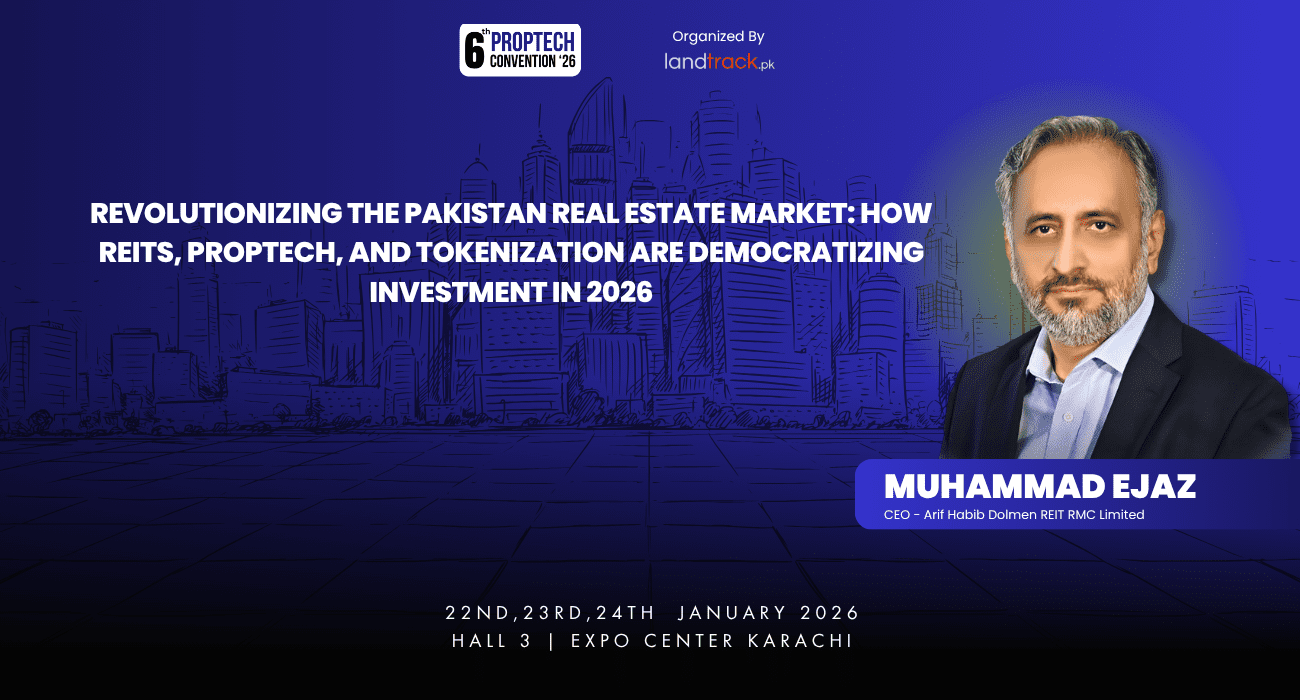
The Pakistan Real Estate Market has historically stood as one of the most resilient and lucrative sectors in the nation’s economy. For generations, it has acted as the ultimate hedge against rampant inflation and a primary driver for wealth accumulation. However, this traditional sector has simultaneously been defined by astronomical barriers to entry, opaque valuation methods, and severe liquidity constraints. Historically, prime commercial and residential property investment was an exclusive domain reserved strictly for high-net-worth individuals, institutional investors, and legacy developers. The average retail investor was effectively locked out of the market’s most profitable opportunities, forced to watch from the sidelines.
As we progress through 2026, a profound paradigm shift is sweeping the nation. The convergence of progressive regulatory frameworks, innovative financial instruments, and disruptive technological integration is completely restructuring the landscape of Property Investment Pakistan. The era of requiring millions of rupees to participate in top-tier real estate developments is rapidly coming to a close. Through the strategic implementation of modernized investment vehicles and decentralized digital infrastructures, the market is finally opening its doors to the broader public, ensuring that wealth generation is no longer a monopolized privilege.
The Affordability Crisis in Pakistan’s Financial Hubs
To truly comprehend the urgent necessity of this market evolution, one must examine the stark economic realities of the country’s urban centers. During a recent industry address, prominent real estate and financial expert Mohammad Ejaz provided a sobering, ground-level breakdown of the market’s fundamental bottlenecks. Ejaz, whose team has been actively working in the REITs business since 2005, emphasized that the ultimate challenge plaguing the real estate sector is a severe lack of accessible capital. There simply is not enough money available to execute the scale of development that the real estate sector desperately needs.
Highlighting the acute affordability crisis in the nation’s financial hub, Ejaz pointed out that in a major metropolis like Karachi, only about 1% of the population can actually afford to make direct real estate investments. Even under the most generous economic assumptions, this demographic of capable investors does not exceed 5% of the total population. This massive disparity underscores a critical, systemic flaw: the inherently capital-intensive nature of physical brick-and-mortar assets disenfranchises up to 99% of the population from participating in the city’s economic growth.
Addressing the audience and congratulating organizers for their persistence in hosting ongoing industry dialogues, Ejaz humorously likened the struggle of integrating real estate with technology to Mahmud Ghaznavi attacking India 17 times. This analogy perfectly encapsulates the relentless effort required over the last decade to break the traditional barriers and bring property investment to the retail market. The solution to this systemic disenfranchisement requires a mechanism that democratizes access and significantly lowers the barrier to entry for the average retail investor.
Breaking the Barrier: Real Estate Investment Trusts (REITs)
To bridge this massive capital gap, the financial sector has fully embraced Real Estate Investment Trusts. The globally-tested solution to the affordability and liquidity crisis is to take large, historically illiquid property assets and break them down into affordable, tradable REIT units.
Under the official regulatory framework, a REIT Scheme operates as a specialized fund where a licensed Management Company pools money from various investors specifically for investment in real estate projects. By purchasing these divisible units, investors gain a proportional, legally binding share in the ownership of these lucrative, income-generating real estate assets.
Income Generation: This proportional ownership entitles the unitholders to a continuous share of the rental income.
Asset Appreciation: Investors are also entitled to capital gains realized upon the asset’s overall appreciation.
Regulated Distribution: To protect the public, the governing dividend distribution policy must be clearly stated in the Offering Document and designed in strict consonance with applicable tax laws.
To ensure maximum liquidity and absolute transparency for the retail public, the regulatory framework dictates that these investments must be channeled through the stock exchange. Through these powerful financial trusts, REITs Pakistan is successfully transforming illiquid concrete skyscrapers into liquid, dividend-yielding financial securities that can be traded with the click of a button.
The SECP REIT Regulations: Enhancing Transparency and Growth
A crucial catalyst for this rapid market maturation is the proactive, forward-thinking stance of the Securities and Exchange Commission of Pakistan (SECP). On January 5, 2026, the SECP officially announced that it had revamped the existing regulatory framework to aggressively stimulate the sector. These landmark amendments to the SECP REIT Regulations were strategically designed to simplify complex operational procedures, dramatically improve governance and control mechanisms, and encourage greater transparency and objectivity in the daily operations of all REIT Schemes.
One of the most vital upgrades in the revised framework is the establishment of clearer, stricter timelines for the legal transfer of real estate and the shares of Special Purpose Vehicles (SPVs). This specific amendment actively promotes the early listing of REIT Schemes on the stock exchange, significantly enhancing their public visibility and accelerating their development as a mainstream capital market asset class. For added investor security, the regulations dictate that under an SPV structure, the REIT Scheme must own a commanding minimum of 75% of the share capital of the SPV, ensuring the fund retains absolute controlling interest over the underlying project.
The SECP also took essential steps to protect the structural integrity of the asset class by streamlining the registration of trust deeds. Furthermore, they refined the legal definition of real estate to distinguish clearly between its passive and active components. By introducing stringent income and asset test requirements in line with international best practices, the regulator ensures that these schemes remain primarily invested in, and derive their primary income from, actual physical real estate. To guarantee fair pricing, independent Valuers are mandated to evaluate the real estate objectively, ensuring their assessments remain completely independent of any external business or commercial relationships.
Crucially, the SECP recognized the unique demographic makeup and specific investor preferences of the Pakistani market by enabling better synchronization with the Shariah governance framework. For a scheme to operate as a Shariah Compliant REIT, it must appoint a designated Shariah Advisor who is responsible for meticulously vetting the foundational trust deed and issuing a compliance certificate. This vital inclusion opens the floodgates for massive amounts of faith-based liquidity to enter the formal property sector, providing ultimate peace of mind to Islamic investors across the country.
Fractional Ownership Real Estate: The Role of PropTech and Blockchain
While traditional REITs have laid the foundational groundwork for public participation, the industry is not stopping at standard stock exchange listings. The market is aggressively integrating legacy real estate business models with advanced digital technology to push the boundaries of true accessibility. This technological renaissance is the driving force behind PropTech Pakistan 2026, which seeks to completely digitize, streamline, and secure property transactions and asset management.
At the forefront of this digital movement is the concept of Fractional Ownership Real Estate. While REITs offer indirect fractional ownership via a heavily pooled fund, emerging PropTech solutions are looking toward decentralized technologies to offer direct, individual fractional stakes in specific assets. As Mohammad Ejaz noted, referencing an insightful presentation by his colleague Adnan, the market is actively exploring decentralized arrangements to facilitate title handovers.
This seamless integration of Blockchain in Real Estate paves the way for the ultimate industry disruptor: Real Estate Tokenization, a transformative shift widely reported on by global financial outlets like Bloomberg Real Estate Insights. Tokenization is the highly secure process of issuing digital tokens on an immutable blockchain ledger, where each token mathematically represents legal ownership of a fraction of a physical asset.
This decentralized approach promises to eliminate hefty intermediary fees, reduce transaction settlement times from weeks down to mere seconds, and allow retail investors to buy micro-shares of a commercial plaza or a luxury apartment complex directly from their smartphones. By merging the rigorous oversight and legal definitions of the SECP with the immutable transparency of blockchain ledgers, Pakistan is aggressively positioning itself to be a regional leader in modern digital property rights.
Market Validation: The Signature Residency IPO Success
Theoretical frameworks, technological promises, and regulatory upgrades are ultimately only as valuable as their real-world adoption. Fortunately for the sector, the retail market’s response has been overwhelmingly positive. The most resounding validation of this new era of democratization is the recent Signature Residency IPO.
The initial public offering for the Signature Residency project was massively oversubscribed, sending a clear, undeniable shockwave through the national financial sector. This staggering public demand—reflected in the historical trading data available on the Pakistan Stock Exchange (PSX)—proves beyond a shadow of a doubt that when premium, previously inaccessible real estate is packaged into regulated, affordable, and transparent financial instruments, the retail appetite is virtually insatiable. Everyday investors—who were historically sidelined due to the severe affordability crisis affecting 95% of the population—are now eagerly deploying their hard-earned capital into the sector. They are utilizing these newly regulated instruments to hedge their savings against inflation and build diversified, institutional-grade portfolios.
Conclusion: The Future of PropTech Pakistan 2026
The convergence of modern financial structuring, progressive regulatory foresight, and next-generation decentralized technology is entirely rewriting the rules of wealth generation in the country. The era of property investment operating strictly as a monopolized venture for the financial elite is permanently fading into history. By breaking down massive, illiquid property valuations into affordable, tradable units, the industry is effectively solving its own capital constraints while simultaneously empowering the middle class.
Driven by the robust oversight of the revamped SECP regulations, the structural safety of SPVs, and the unyielding transparency enforced by independent trustees and Shariah advisors, the market has never been safer for retail participants. As we look ahead, the continuous evolution of investment trusts, combined with the incredibly disruptive potential of tokenization, guarantees that the future of the Pakistan Real Estate Market is decentralized, digital, and democratized.
Frequently Asked Questions
What are the new SECP REIT Regulations in Pakistan?
The SECP revamped the 2022 REIT Regulations to simplify procedures, improve governance, and ensure transparency. Key changes include clearer timelines for asset transfers and better synchronization with the Shariah governance framework.
How is blockchain changing fractional ownership in real estate?
Blockchain facilitates decentralized arrangements for title handovers and enables real estate tokenization. This allows physical assets to be divided into digital tokens, significantly lowering entry barriers and reducing transaction times for retail investors.
What is a Real Estate Investment Trust (REIT)?
A REIT is a regulated fund where a licensed management company pools investor money to finance real estate projects. Unitholders gain a proportional share of the property, entitling them to rental income and capital gains
Why is there an affordability crisis in Pakistan's real estate market?
There is a severe lack of accessible capital for large-scale developments. Currently, only 1% to 5% of the population in major financial hubs like Karachi can afford direct, whole-asset real estate investments
How do REITs solve the real estate liquidity problem?
REITs take large, illiquid property assets and divide them into affordable, tradable units. Investors can easily buy and sell these units through the stock exchange, providing immediate market liquidity
What is the role of a Shariah Advisor in Pakistani REITs?
For a Shariah Compliant REIT, a designated Shariah Advisor must vet and approve the foundational trust deed. This ensures the investment framework aligns completely with Islamic financial principles and regulations
What is real estate tokenization?
Tokenization is the process of issuing digital tokens on an immutable blockchain, with each token mathematically representing legal fractional ownership of a physical property. This democratizes market access for the retail class.
What was the impact of the Signature Residency IPO?
The Signature Residency IPO was a massively oversubscribed initial public offering. It clearly demonstrated the overwhelming retail demand for regulated, affordable, and transparent real estate investment instruments in the Pakistani market.
How do SPVs (Special Purpose Vehicles) work in Pakistani REITs?
In an SPV structure, the REIT Scheme invests in a limited liability company used as a conduit to execute the project. The REIT Scheme must legally own at least 75% of the SPV’s share capital.
What is PropTech?
PropTech, or property technology, integrates digital innovations like blockchain and smart contracts into traditional real estate models. It aims to fully digitize transactions, enhance security, and increase market accessibility for everyday investors.
2 Comments