

The landscape of real estate pakistan 2026 is undergoing a fundamental and unprecedented transformation. Historically characterized by a deep-seated speculative culture—where trading paper “files” dominated the market—the industry is executing a structural realignment toward transparency, physical utility, and institutionalized finance. As macroeconomic indicators and property market analytics show signs of stabilization with inflation hovering around 5-7% in certain segments, end-users and investors alike are prioritizing tangible assets over speculative promises.
For investors, developers, and policymakers, understanding these shifting dynamics is no longer optional. This comprehensive guide synthesizes market data, government reforms, and expert insights to present a definitive outlook on the future of property development and financing in Pakistan.
1. Insights from the Core: Bridging the Trust Deficit
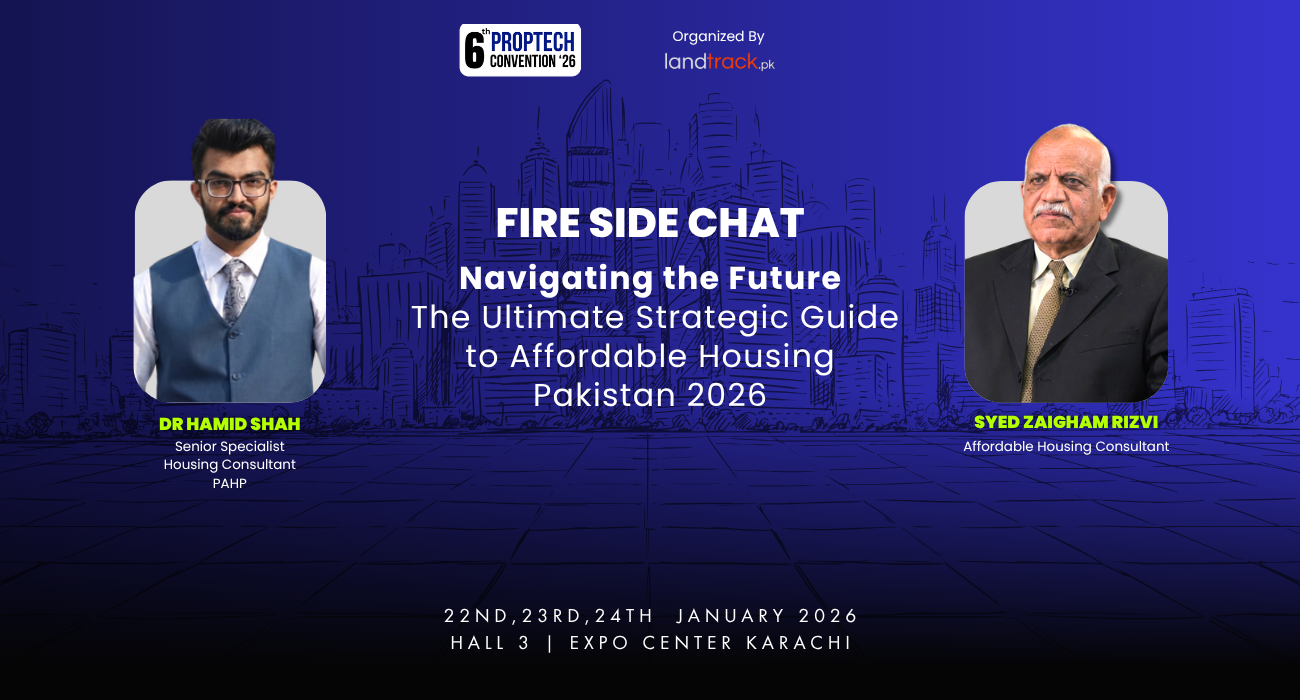
The recent PropTech Convention 2026 pakistan, held at the Karachi Expo Center, served as a pivotal moment for redefining the industry’s operational standards. The overarching theme of the convention was the critical transition from a “Dream” phase of marketing to a “Machinery” phase focused on on-ground execution.
During the highly anticipated real estate panel pakistan 2026, industry leaders dissected the psychological and systemic barriers holding the market back.
Shoaib Anees (Director, Zameen.com): Representing the immense data muscle of zameen.com digital real estate pakistan, Anees emphasized that the “Trust Deficit” remains the primary hurdle. He highlighted that consumers are in a “survival mode,” demanding basic assurances: “Will I get what I’m buying? Is it legal? Will the quality be maintained?”. Anees noted that bridging this gap requires moving beyond traditional property dealing toward comprehensive consumer education and digital verification frameworks.
Rahil Haroon (Representing Realtors Association): Haroon stressed the urgent need to end speculative, deceitful marketing. He pointed out that the lack of clear, investor-protecting policies means that capital is fundamentally unsecure. He stated, “We need the courage to call what is right, right, and what is wrong, wrong,” urging platforms to stop promoting developers who fail to deliver, regardless of marketing budgets.
Abdul Karim (Olympic Developers): Providing the developer’s perspective, Karim highlighted the need to build a society that values quality and ownership. However, he strongly criticized the “bureaucratic disconnect” in policy-making. He argued, “If they are going to make policies without consulting the stakeholders on the ground, those policies cannot be implemented”.
The transition is already visible as the market shifts away from opaque cash deposits toward state-monitored escrow accounts and blockchain-enabled fractional ownership, laying the groundwork for a truly transparent real estate ecosystem pakistan.
2. Unpacking the “Apna Ghar” Construction Package
To address the severe nationwide housing shortage—estimated at 1.6 million units—the federal government has rolled out the ambitious “Apna Ghar” housing programme. This initiative fundamentally reshapes the landscape for affordable housing finance pakistan by providing unprecedented support to first-time homebuyers.
Key parameters of this landmark government initiative include:
Enhanced Loan Limits: Eligible applicants can now secure financing up to PKR 10 million, a substantial increase designed to match the rising costs of urban land and materials.
Subsidized Markup: The scheme features a highly attractive fixed markup rate of 5% for the first 10 years of the loan, mitigating the impact of historically high commercial interest rates set by the State Bank of Pakistan (SBP).
Extended Repayment: Borrowers benefit from a 20-year repayment timeline, bringing monthly installments down to manageable levels (e.g., approximately PKR 16,500 for a PKR 2.5 million loan).
Expanded Eligibility: Financing now covers the construction or purchase of homes up to 10 Marla, as well as apartments up to 1,500 square feet.
Backed by a massive PKR 321.96 billion subsidy budget, the government aims to finance the construction of 500,000 homes over a four-year period. This massive injection of capital is expected to act as a powerful economic multiplier, significantly boosting the broader construction industry pakistan 2026 by driving demand across allied sectors like cement, steel, and electrical equipment.
3. Institutional Evolution and Mortgage Scaling
The driving force behind deploying these government subsidies is the modernization of financial institutions. As of early 2026, the hbfc housing finance pakistan 2026 landscape is undergoing rapid institutional evolution, spearheaded by the impending privatization of the House Building Finance Company (HBFC).
During the PropTech convention, Salman (representing HBFC), outlined the technical challenges historically limiting mortgage penetration. He noted that unlike markets like Melbourne where 99.7% of property is mortgaged, the concept is fundamentally misunderstood in Pakistan. He identified three primary hurdles
Documentation Latency: Heavy reliance on manual land records and physical verification slows down transaction speeds.
Adoption Friction: A lack of digital literacy among real estate professionals hinders the adoption of streamlined CRM and processing tools.
Regulatory Void: The absence of a centralized regulatory authority limits institutional confidence. Furthermore, Salman pointed out the volatility developers face, stating, “Every 15 days, a policy or a rate changes… making it difficult to maintain a consistent pricing mechanism”.
Despite these challenges, hbfc mortgage solutions pakistan are aggressively scaling. The institution has seen a 16.4% year-on-year growth in outstanding loans for bank employees, demonstrating resilient demand for housing credit. With new leadership under CEO Syed Muhammad Talib Rizvi, HBFC is navigating the transition toward becoming a privately-held entity while serving as the primary engine for the Apna Ghar program.
4. Policy Reform: Curing “Institutional Spaghetti”
Perhaps the most critical vulnerability in the current market is what industry experts like Rahil and Karim termed “Institutional Spaghetti”—the overlapping, conflicting, and often archaic roles of federal, provincial, and local housing authorities.
To mature the market, stakeholders are universally demanding a Real Estate Regulatory Authority (RERA). Currently, the lack of a unified regulatory body exposes investors to indefinite project delays and severe capital mismanagement. Establishing RERA is the non-negotiable first step toward enforcing project delivery timelines and protecting consumer capital.
Furthermore, experts like Zaigham Rizvi argue that solving urban housing deficits requires market-based solutions rather than state coercion. Incentivizing private developers to execute slum redevelopment programs can upgrade informal settlements (like Karachi’s Neelam Colony) on-site, providing better homes for residents while unlocking billions in underlying land value.
5. Karachi’s Evolution and the Blue Economy
Analyzing urban development trends pakistan, the karachi real estate market 2026 is defined by two distinct spatial movements: a “Vertical Revolution” and an “Outward Expansion”.
Due to severe land scarcity and high costs in the city center, developers are aggressively building upward. High-rise apartment complexes in areas like Scheme 33 and Gulistan-e-Jauhar are dominating the market, offering efficiency, security, and attractive rental yields of 4-6% for investors. Simultaneously, improved connectivity via the Malir Expressway has transformed peripheral areas like DHA City and Bahria Town into viable, year-round livable communities.
Beyond the urban core, the market is making a strategic pivot toward the “Blue Economy”. Recognizing Pakistan’s 1,300km coastline as a massively underutilized asset, developers are shifting focus away from seasonal northern tourism toward the Makran Coastal Highway.
Karachi currently suffers from a severe 5-star hospitality deficit, having seen no major luxury hotel developments in 50 years—a stagnation estimated to drag the national CAGR down by -0.8%. This vacuum is being filled by private, sustainable eco-resorts that integrate off-grid renewable energy and nature-based solutions (like mangrove restoration), opening highly lucrative avenues for coastal real estate development.
6. The Era of Digital Asset Management
The integration of property technology is permanently altering how assets are bought, sold, and managed. The digital real estate pakistan 2026 ecosystem is moving past static online listings into the realm of AI-powered analytics, virtual tours, and automated lead generation.
Furthermore, the democratization of real estate ownership is accelerating through Real Estate Investment Trusts (REITs). With 28 active REITs approved by the SECP as of January 2026, middle-income locals and overseas Pakistanis can now gain exposure to premium property assets without the massive capital requirements or management hassles of direct ownership.
For those engaging in direct property investment pakistan 2026, the strategy has shifted from speculation to data-driven due diligence. The new standard for smart investment is the “70% Rule”—deploying capital only into projects where at least 70% of the physical infrastructure (sewerage, roads, electricity grids) is already visible on the ground.
Conclusion
The transition of the Pakistani property market in 2026 is a necessary and permanent structural realignment. By embracing digital trust layers, formalizing mortgage finance through robust institutions like HBFC, and pivoting toward high-utility assets like vertical housing and coastal eco-resorts, the industry is laying the foundations for sustainable growth. As summarized by the panel, for developers and investors, the mandate is clear: the future belongs to those who execute with transparency, leverage technological integration, and deliver tangible utility to the end-user.
Frequently Asked Questions
What are the current hbfc mortgage solutions pakistan?
HBFC offers modernized mortgage solutions featuring enhanced loan limits up to PKR 10 million, extended 20-year repayment timelines, and subsidized markup rates, particularly supporting the government’s Apna Ghar affordable housing initiative.
How do urban development trends pakistan affect property investment?
Urban development trends in Pakistan for 2026 are shifting investments toward high-yield vertical housing in city centers and sustainable coastal eco-resorts, moving away from speculative file trading toward tangible, utility-driven assets.
Is zameen.com digital real estate pakistan improving market trust?
Yes, Zameen.com is actively bridging the market’s trust deficit by providing data-driven analytics, transparent digital verification frameworks, and educational resources, shifting the industry from opaque practices to verified transactions
What is the future of the construction industry pakistan 2026?
Backed by the PKR 321.96 billion Apna Ghar subsidy, the construction industry in Pakistan is projected to experience massive growth in 2026, driving demand for allied sectors like cement, steel, and eco-friendly building materials.
What were the key takeaways from the real estate panel pakistan 2026?
The panel emphasized bridging the trust deficit through consumer education and digital verification, marking a definitive shift toward a transparent real estate ecosystem pakistan.
Where are the best opportunities in the karachi real estate market 2026?
Investors are finding the highest yields in vertical high-rise apartments near the city center and sustainable eco-resorts emerging along the Makran Coastal Highway.
How is digital real estate pakistan 2026 changing property buying?
It is transitioning the market from static listings to AI-powered analytics, virtual tours, and blockchain-enabled fractional ownership, allowing for secure, data-driven investments.
What is the safest strategy for property investment pakistan 2026?
Investors should apply the “70% Rule,” committing capital only to documented projects where at least 70% of physical infrastructure—like roads, sewerage, and electricity grids—is visibly complete on the ground.